A solitary Canary Island date palm rising majestically above a coastal harbor is far more than a picturesque holiday backdrop. Its broad, massive crown, sculpted diamond-patterned trunk, and arching silver-green fronds belong to an ancient species sculpted by oceanic isolation, shifting microclimates, and thousands of years of island evolution. Understanding the natural history and evolutionary resilience of Phoenix canariensis reveals why this iconic palm is so fundamentally rooted in the identity of Tenerife—whether viewed from a beachfront promenade, a volcanic ravine, or the sunlit deck of a private yacht.
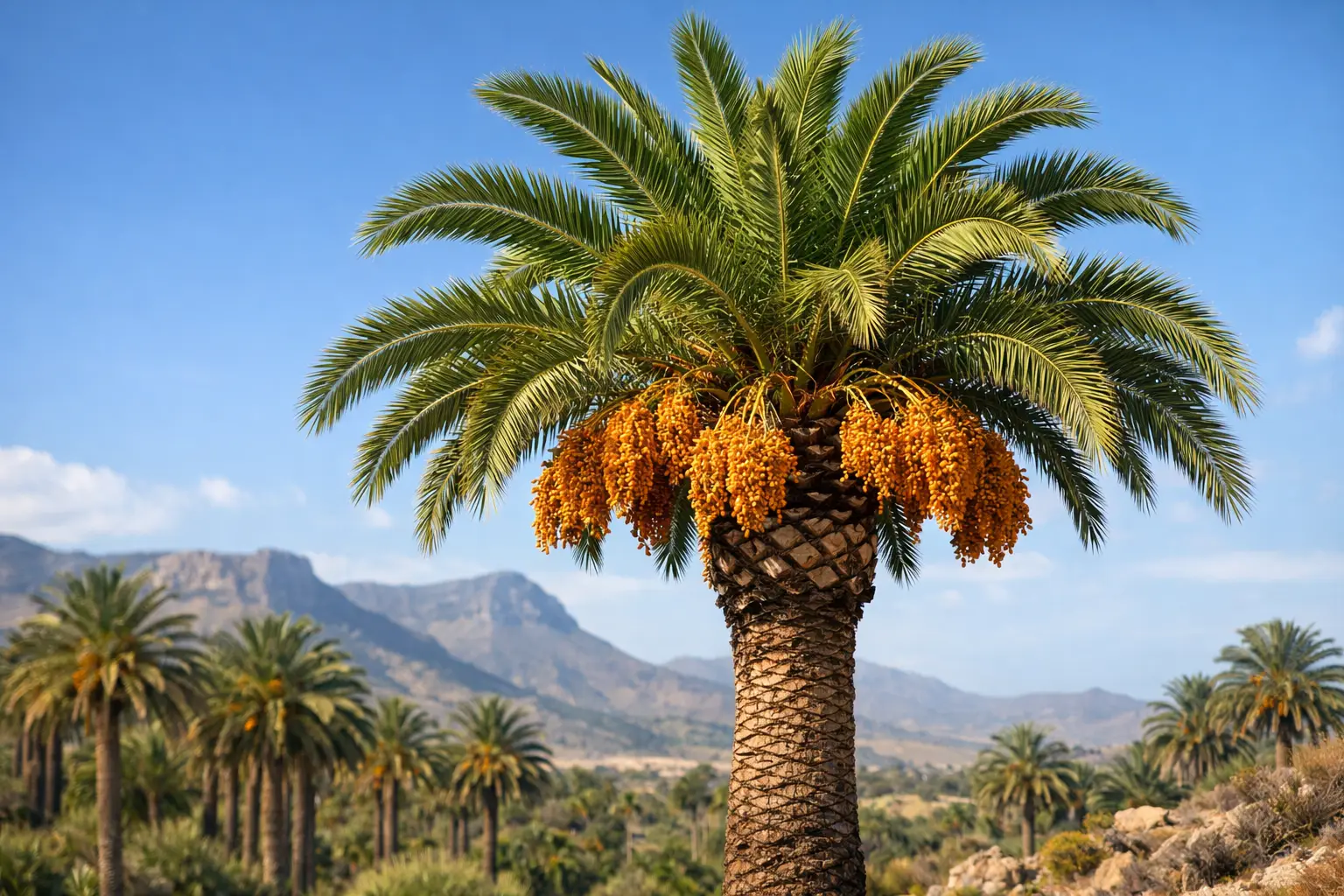
Phoenix canariensis, universally recognized as the Canary Island date palm, is a botanical species endemic to the Canarian archipelago. It belongs to the broader Phoenix genus—a ancient family of pinnate-leaved palms distributed across Africa and Asia—but separated from its continental relatives after ancestral seeds established themselves on the isolated volcanic islands millions of years ago.
Isolation on oceanic islands presents extreme evolutionary pressures: limited land area, microclimates divided by steep mountain barriers, and volatile rainfall patterns. Over millennia, ancestral palms adapted specifically to the Canary environment. They evolved thick, water-storing trunks, massive root systems capable of tapping into subterranean volcanic aquifers, and heavy, wind-resistant canopies.
Unlike the commercial date palm (Phoenix dactylifera), which features a slender trunk and produces large, sugary edible dates, the native Canary palm evolved a far more powerful, robust architecture. Its dates are small, fibrous, and less commercially viable as fresh fruit, but its ecological role as a cornerstone of island biodiversity is unmatched.
Long before Tenerife evolved into a premier luxury travel destination, natural palm groves marked crucial oases across the arid landscape. Wild palms flourished in the bottoms of deep ravines (barrancos) and valley basins where underground water naturally accumulated beneath dry surface soil.
The aboriginal Guanches revered these palms, utilizing their tough fronds for roofing and weaving, while using their heavy trunks as natural beams. Following the European conquest, islanders refined these traditional uses. On neighboring La Gomera, sustainable sap harvesting developed into an art form: tapping the crown to collect guarapo, which is slow-cooked into the famous miel de palma (palm syrup).
Understanding this utilitarian past dispels the misconception that these giant palms are mere decorative landscaping. They are deeply functional living artifacts that sustained human survival on these rugged volcanic islands for centuries.
Tenerife's unique topography presents extreme microclimate shifts: the arid, sun-baked south-west contrasts sharply with the humid, trade-wind-fed northern valleys. Phoenix canariensis thrives across these distinct environments due to its remarkable physiological adaptability.
Once established, a mature Canary palm withstands scorching heat, salt spray, ocean gales, and extended droughts. Its massive, fibrous trunk acts as a water reservoir, while its thick, waxy fronds minimize transpiration during dry spells. This hardiness made the species exceptionally attractive to 19th-century botanists and international landscape architects.
Exported from the Canary Islands during the Victorian era, Phoenix canariensis quickly became the premier symbol of prestige and luxury across the Mediterranean, California, Australia, and the French Riviera. Planting a Canary palm outside a grand hotel or along an ocean promenade was the ultimate architectural statement of elegance.
While the global popularity of Phoenix canariensis elevated the international profile of the Canary Islands, it also created serious biological challenges back home in the archipelago:
To combat these issues, the Canarian government enacted strict environmental protection laws. Today, wild palm groves are designated protected natural habitats, and strict quarantine protocols regulate palm pruning and transportation across the islands.
Identifying a pure Phoenix canariensis among other ornamental palms is straightforward once you know its defining characteristics:
For guests aboard a private yacht charter in south Tenerife, Canary Island date palms form an integral part of the coastal skyline. Viewing the island from the water reveals how these towering green crowns break the stark, arid lines of the volcanic hillsides.
Gliding past the coastal promenades of Costa Adeje or the historic harbor walls of Las Galletas at golden hour, the silhouettes of Phoenix canariensis stand out sharply against warm sunset skies. They provide a physical bridge connecting modern coastal luxury to the wild, untouched botanical history of the Atlantic.
The Canary Island date palm is officially recognized as the natural plant symbol of the island of Gran Canaria and a protected regional emblem across the entire archipelago. Appreciating these magnificent trees means viewing them not merely as resort decor, but as resilient evolutionary survivors that have witnessed the entire human story of Tenerife.
When you next admire a giant Phoenix canariensis framing a harbor view or rising beside an ancient ravine, take a moment to reflect on its journey: from an isolated volcanic adaptation to a world-famous botanical icon that remains forever rooted in its Canarian home.
Yes. Phoenix canariensis is strictly endemic to the Canary Islands, meaning it evolved naturally across the archipelago. It is native to all seven main islands, including Tenerife.
Technically yes, but they are not commercially desirable. The fruits (known locally as támaras) consist mostly of a large, hard seed surrounded by a thin layer of dry, fibrous flesh. Commercial dates come from a different species, Phoenix dactylifera.
Under healthy conditions, a Canary Island date palm can live for 100 to 300 years, growing very slowly and developing a massive, thick trunk over centuries.
Phoenix canariensis has a much thicker trunk, a significantly fuller, denser crown of leaves, and small non-commercial fruit. Phoenix dactylifera (true date palm) has a slender trunk, an open canopy, and produces large, sweet dates.
Miel de palma is a traditional Canarian delicacy made by collecting the sweet sap (guarapo) of the Canary Island date palm and slowly boiling it down into a rich, dark syrup. It is traditionally produced on the neighboring island of La Gomera.