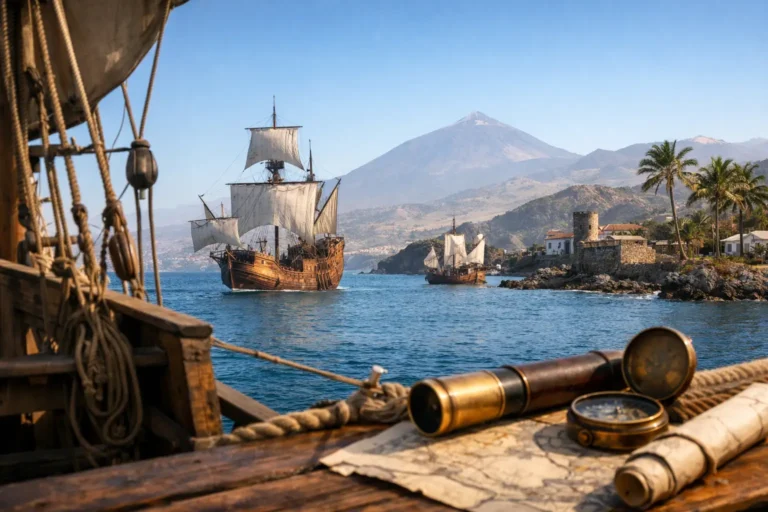
A piercing, melodic whistle cuts clean across a deep volcanic ravine, carries effortlessly over terraced palm groves, and reaches a distant hillside village seconds later. That striking sound is not a novelty performance staged for tourists; it is a fundamental part of Silbo Gomero—the extraordinary whistled language of La Gomera. This living form of communication, entirely shaped by the island's rugged geography, stands today as one of the most brilliant and well-preserved cultural traditions in the entire Canary Islands.
For discerning travellers exploring Tenerife who want to look far beyond the standard guidebook highlights, Silbo Gomero offers something rarer than a mere scenic viewpoint. It provides an intimate look into how island life once functioned, how human communities adapted to isolated landscapes, and why local Canarian identity remains so closely tied to the earth. Gaining perspective on this heritage enriches your journey, whether you are admiring the distant silhouette of La Gomera from a premium yacht charter or planning a multi-island voyage.
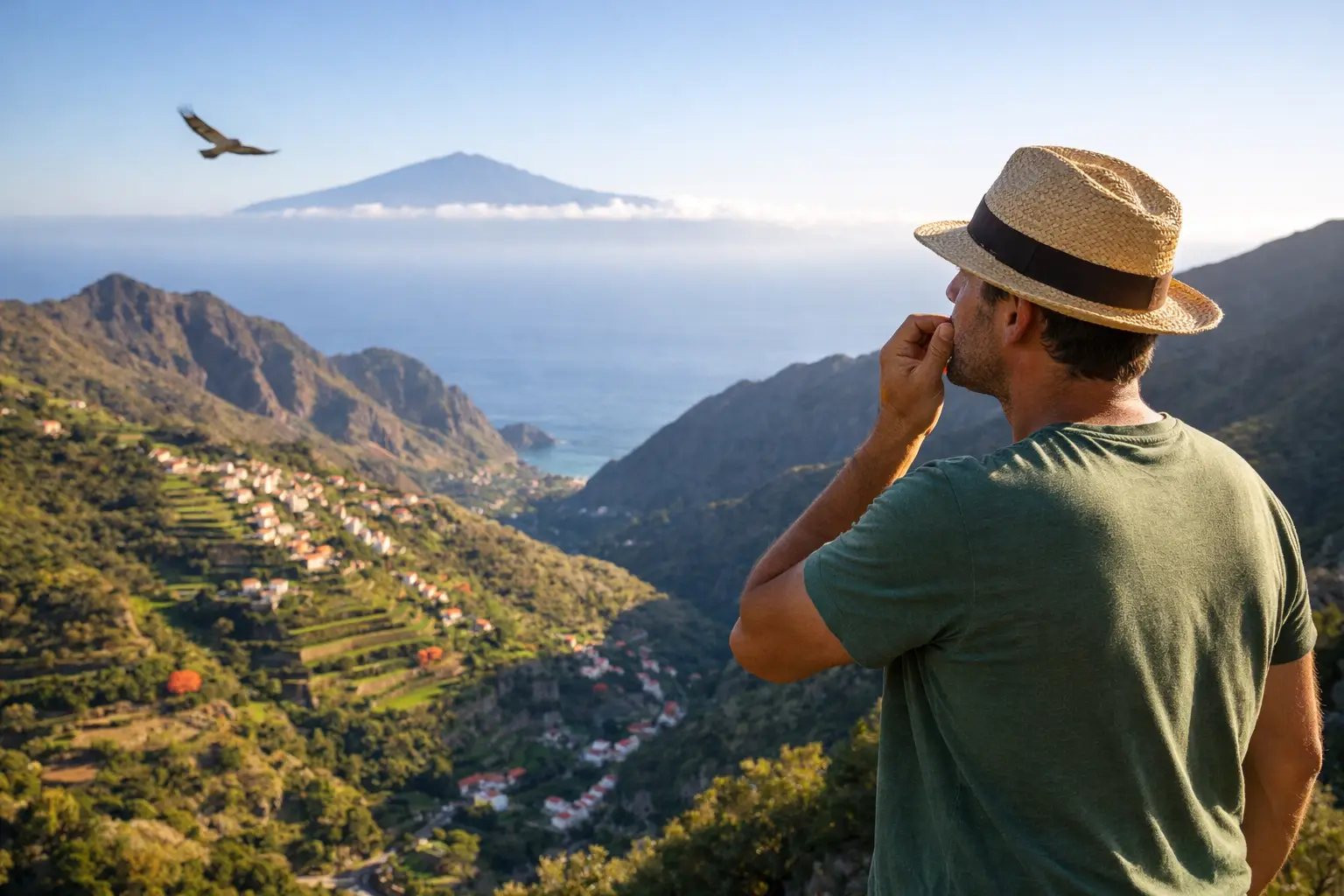
Silbo Gomero is not a separate language with its own unique vocabulary or distinct grammar. Instead, it is a highly sophisticated whistled register that replicates spoken Spanish. Historically, it allowed messages to travel across the dramatic barrancos (ravines), steep volcanic valleys, and cliffs of La Gomera far more efficiently than the human shouting voice ever could.
Linguistically, the mechanics of Silbo Gomero are fascinating. Master whistlers, known as silbadores, use their fingers, tongue, lips, and cupped hands to compress airflow and create intense, high-frequency acoustic tones. The language systematically simplifies the complex sounds of spoken Spanish into **four distinct whistled consonants and two basic vowels**. By varying the pitch, resonance, and duration of the whistle, a skilled silbador can articulate an infinite number of words, coordinates, names, and complex sentences, relying heavily on the context of the conversation to ensure flawless understanding over immense distances.
The deepest roots of this whistled system predate European arrival, tracing back directly to the island's original pre-Hispanic inhabitants—the ancient North African Berber tribes often broadly referred to as the Guanches. Early French and Spanish chroniclers who arrived in the Canary Islands during the early 15th century documented with absolute amazement that the native population of La Gomera could "speak with their lips as if they had no tongues," communicating fluidly across vast mountain ranges.
Following the Castilian conquest, the indigenous language was gradually replaced by Spanish. However, the practical necessity of the whistled code was so profound that the conquerors and early settlers adopted it themselves. Silbo Gomero successfully adapted, mapping the phonetic structure of Castilian Spanish onto its existing whistled tones. This fluid linguistic evolution is the primary reason the tradition survived for centuries, operating as a vital social tool for farmers, shepherds, and rural communities rather than being frozen in time as a relic of the past.
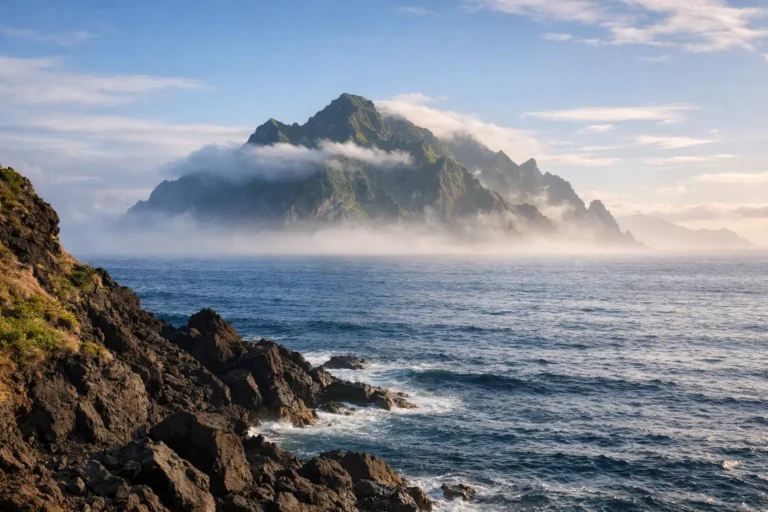
To truly understand why Silbo Gomero developed, one must study the acoustic geography of La Gomera. The island rises abruptly from the Atlantic, featuring a massive central mountainous core cut by deep, radiating ravines. This crumpled terrain creates natural amphitheaters and highly effective acoustic corridors.
While an ordinary spoken or shouted sentence instantly fractures and degrades due to mountain winds and echo interference, a controlled, high-frequency whistle pierces through the air currents with absolute clarity. In ideal weather conditions, a single well-placed whistle can travel up to three or four kilometers across a valley. Before the introduction of modern roads, postal systems, or telephones, whistling was not a pastoral art form—it was a vital, highly efficient survival tool used to share community news, coordinate agricultural labor, sound emergency fire alarms, or warn villages of arriving ships.
During the mid-to-late 20th century, the traditional lifestyle of La Gomera underwent a massive transformation. The construction of modern asphalt roads, the widespread expansion of telephone networks, and the economic migration of younger generations away from rural agriculture toward coastal tourism severely threatened the survival of the language. By the 1980s, Silbo Gomero was on the brink of total extinction, kept alive only by a handful of elderly silbadores in remote mountain hamlets.
The successful salvation of Silbo Gomero is a triumph of local political and community action. Recognizing that a vital piece of human heritage was vanishing, the island’s government made the historic decision to make the study of Silbo Gomero **mandatory in all primary and secondary schools** across La Gomera. This institutional protection ensured that every younger generation learned the historical technique naturally, restoring its status as a living symbol of cultural pride. This spectacular preservation effort culminated in 2009, when UNESCO officially inscribed Silbo Gomero on the Representative List of the Intangible Cultural Heritage of Humanity.
For visitors setting sail from the crowded resorts of south Tenerife, looking out across the blue waters of the Atlantic toward the mist-capped peaks of La Gomera is a highlight of any holiday. Gaining a deep understanding of the human heritage that thrives on that neighboring island transforms it from a picturesque backdrop into a living museum of human resilience and brilliance.
The Atlantic ocean has always operated as both a barrier and a bridge connecting the Canary Islands. While Tenerife developed grand merchant ports and architectural cities, isolated La Gomera turned inward, developing a linguistic masterpiece from raw necessity. At Royal Ocean, we believe that the ultimate luxury of travel lies in these rich, hidden layers of context. Gaining an intellectual appreciation for the culture of the waters you cross doesn't make a relaxed wildlife cruise or a private charter feel heavier—it adds a sophisticated dimension of authenticity, making your time at sea feel profoundly exclusive and unforgettable.