Stand on Tenerife’s volcanic shoreline long enough, and the island begins to feel vastly older than its beach resorts, modern marinas, and sunlit terraces. Long before the first sails appeared on the horizon, a remarkable civilization thrived here. The story of the Guanches—the indigenous people of Tenerife—sits quietly beneath the modern landscape, shaping place names, culinary traditions, and sacred cave sites. For travellers seeking more than a surface-level holiday, understanding Guanche culture offers a profound connection to the island, rooted in human survival, isolation, and an enduring relationship with the land and sea.
For anyone enjoying the coastline in premium comfort—whether tracing the dramatic cliffs of Los Gigantes or relaxing in hidden coves from the deck of a private yacht—this history adds an unexpected layer of richness. Tenerife is not simply a beautiful holiday destination; it is an island with a deep, haunting memory. Gaining insight into its first inhabitants transforms a simple cruise into a much more meaningful journey.
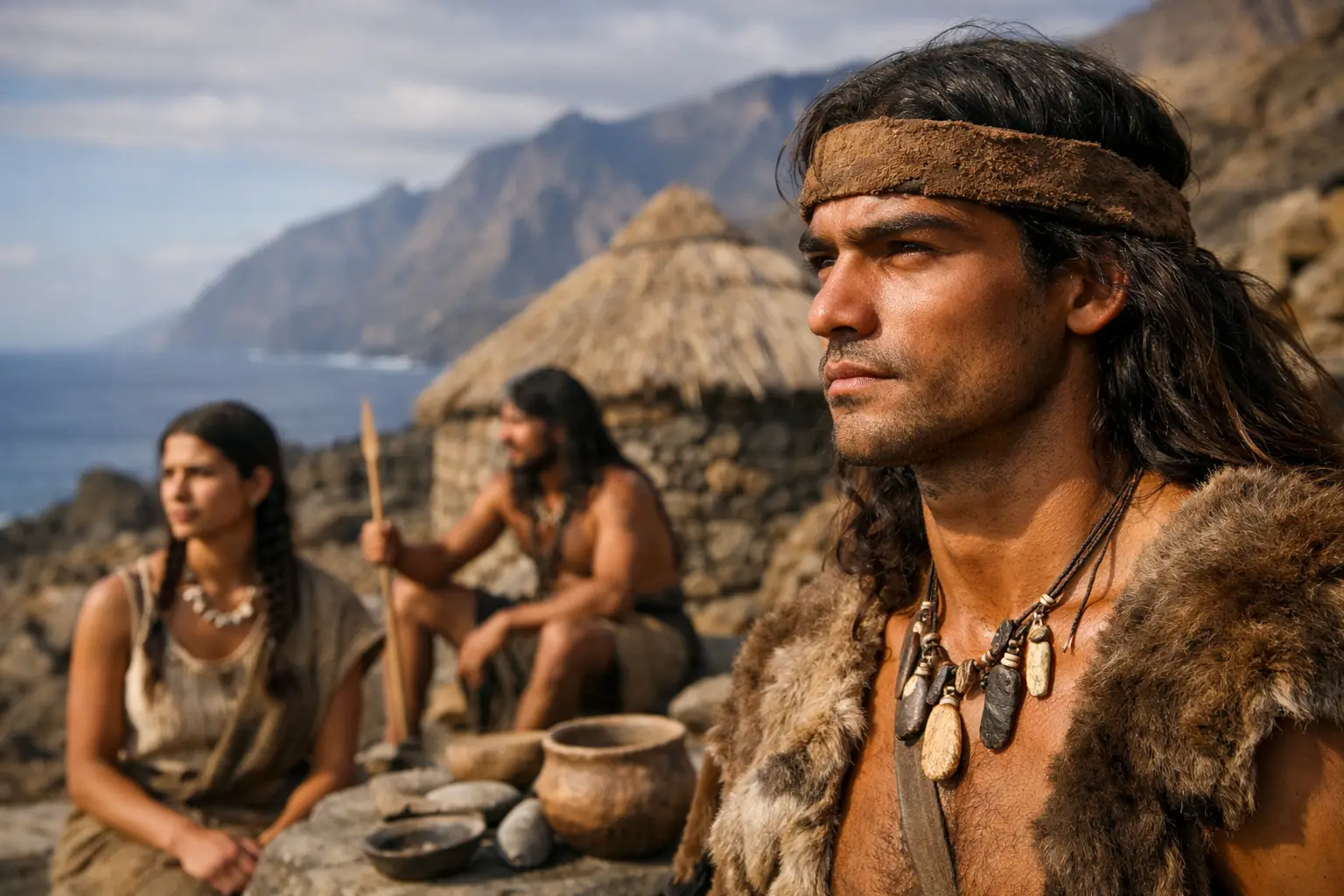
While casual travel writing often uses the term "Guanche" to describe all pre-Hispanic inhabitants of the Canary Islands, it strictly refers only to the indigenous people of Tenerife. Each island in the archipelego was actually populated by distinct tribal groups with their own dialects, social structures, and customs. The islands were culturally isolated from one another, as the native populations surprisingly lacked the knowledge of seafaring navigation.
Genetic and archaeological research confirms that the earliest settlers arrived in the Canaries around the 1st millennium BC, carrying distinct Berber origins from North Africa. For over fifteen centuries, these communities developed in total isolation from the rest of the world. In Tenerife, this gave rise to a highly structured pastoral society divided into nine distinct territorial kingdoms known as menceyatos. Each kingdom was ruled by a absolute monarch called a mencey, assisted by a council of nobles. This was far from a primitive society; it was a sophisticated, law-governed culture beautifully adapted to a rugged volcanic environment.
Daily life for the Guanches was dictatated by the natural microclimates of Tenerife. Their economy was primarily pastoral, centered on herding sheep and goats. These animals provided crucial resources: milk, meat, bone tools, and leather for clothing (known as tamarco). Agriculture was also vital, particularly the cultivation of barley and wheat. The Guanches toasted these grains and ground them into a dense flour called gofio. Remarkably, gofio remains a staple of modern Canarian cuisine today, serving as a direct culinary bridge across five hundred years of history.
In a landscape dominated by volcanic rock and steep ravines, the Guanches became master troglodytes. They lived predominantly in natural volcanic caves, which provided excellent, stable insulation against the intense summer heat and chilly winter Atlantic winds. Craftsmanship was remarkably resourceful; because the Canary Islands completely lack exploitable metal ores, the Guanches bypassed the Bronze and Iron Ages entirely. Instead, they relied on volcanic obsidian stone, goat bones, and hard endemic woods to create sharp tools, spears, and beautifully smoothed, hand-formed pottery.
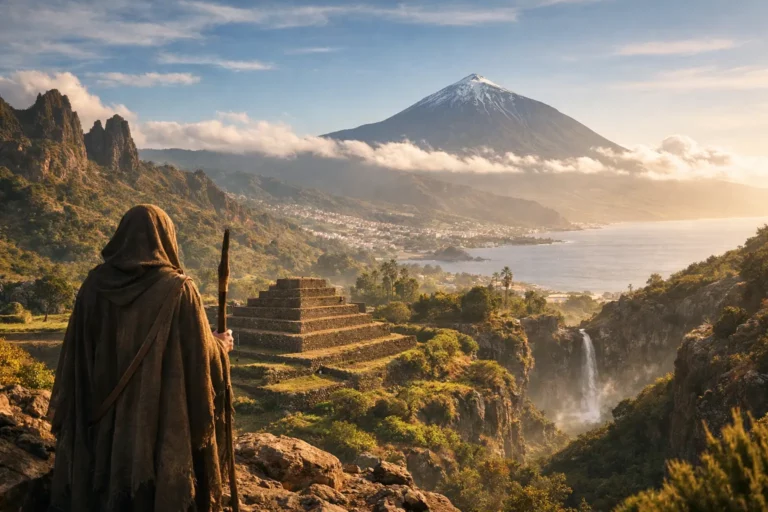
To truly appreciate Tenerife, one must view its geography through sacred eyes. To the Guanches, the island was a living canvas of gods and spirits. They worshipped a supreme creator deity, Achamán, and held a profound reverence for the sun and moon. However, their spiritual focus was drawn toward the towering peak of Mount Teide. They called the volcano Echeyde, believing it to be the gateway to the underworld and the dwelling place of Guayota, a malevolent demon associated with fire and volcanic destruction.
Perhaps the most extraordinary aspect of Guanche culture was their practice of mummification, a ritual reserved strictly for royalty and elite nobles. Special embalmers used a mixture of pine resin, crushed pumice stone, and goat fat to preserve the bodies of the deceased, which were then wrapped in fine leather skins and placed in remote, inaccessible burial caves. Today, these mummies—many of which can be studied at the MUNA museum in Santa Cruz—provide incredible insights into the health, status, and complex spiritual beliefs of this ancient Atlantic society.
The 15th-century Castilian conquest altered the destiny of the Canary Islands forever. Tenerife was the final and most difficult island to fall. The Guanches fought fiercely under leadership like Mencey Bencomo, handing the Spanish crown a legendary defeat at the Battle of La Matanza in 1494. However, plagued by a devastating disease known as the "Guanche modorra" (likely typhus or influenza) and facing superior steel weaponry, the last native resistance crumbled at Los Realejos in 1496.
While the sovereign Guanche society was dismantled through war, enslavement, and forced assimilation, the people themselves did not completely vanish. Genetic studies show that a substantial percentage of modern Canarian DNA directly descends from the indigenous maternal lines. The Guanche legacy did not die; it integrated. It lives on in the whistle language of La Gomera, the traditional Canarian wrestling (Lucha Canaria), and the ancient pastoral technique of leaping over steep ravines with long wooden poles (Salto del Pastor).
For most visitors, a holiday in Tenerife begins and ends with sunshine, beach clubs, and ocean views. However, the island becomes infinitely more memorable when you connect its natural landmarks to its human past. When you rent a boat and sail along the southern coast from a port like Puerto Colón, you are tracing the boundaries of the ancient kingdoms of Adeje and Abona.
Looking back at the steep barrancos (ravines) and volcanic cliffs from the quiet luxury of a yacht deck changes your perspective. Those dramatic rock faces stop being mere backdrops for photographs and reveal themselves as ancient fortresses, grazing routes, and sacred burial sanctuaries.
True luxury on a holiday is not just about the quality of the service or the chill of the wine; it is about depth, context, and a genuine connection to your destination. Understanding the resilience of the civilization that built a life out of volcanic rock and raw belief makes your time on the water feel far more profound, exclusive, and unforgettably rich.