A quiet volcanic slope in Tenerife can hold a much bigger story than its dramatic outline suggests. Island gigantism and dwarfism in Canary Islands evolution help explain why some animals became unexpectedly large, while others evolved smaller bodies after generations of living apart from mainland predators, competitors and changing environmental conditions.
The Canary Islands are celebrated for whale watching, black-sand beaches, ravines and clear Atlantic horizons. Yet their natural history is equally compelling. Their distance from mainland Africa, varied geological ages and sharply contrasting habitats created conditions in which species could diverge in unusual ways. Some lineages expanded into ecological roles that were less available on the mainland, while others adapted to limited food and space by becoming smaller.
Island gigantism occurs when an animal evolves to become larger than its mainland relatives. Island dwarfism is the reverse pattern, in which larger animals become smaller over many generations. Neither process happens quickly, and neither follows a universal rule. They are evolutionary responses to particular combinations of food availability, predators, competition, habitat and climate.
On an island, the ecological balance found on a mainland can change dramatically. Some predators may be absent, competition may be reduced and food resources may be distributed differently. A small animal that would face intense predation on the mainland may survive longer and occupy a broader ecological role. At the same time, a large animal living where food is scarce may benefit from a smaller body that requires less energy.
This is why island evolution is so interesting. Body size is only one possible response. Over generations, populations can also change their diet, behaviour, limb proportions, feeding structures and reproductive strategies as they adapt to local conditions.
Before a terrestrial species can evolve on an oceanic island, it first has to cross open water. Colonists may arrive by flying, swimming, rafting on vegetation or, in rare cases, being carried by storms. The first population represents only part of the genetic diversity of the mainland species.
This limited starting population can then follow its own evolutionary path. Genetic drift and natural selection act within the new environment, gradually separating an island population from its mainland relatives. Over sufficiently long periods, this process can produce endemic species found nowhere else.
The Canary Islands provide particularly interesting examples because the archipelago is not one uniform environment. Tenerife, Gran Canaria, La Palma, La Gomera, Lanzarote, Fuerteventura and the smaller islands differ in altitude, rainfall, vegetation and geological history. A cool, cloud-fed laurel forest creates very different conditions from a dry coastal landscape.
The same isolation that encourages evolutionary divergence can also create vulnerability. Species that developed without certain predators or competitors may have few effective defences when new animals arrive. Cats, rats, grazing animals and other introduced species have contributed to serious declines among island wildlife.
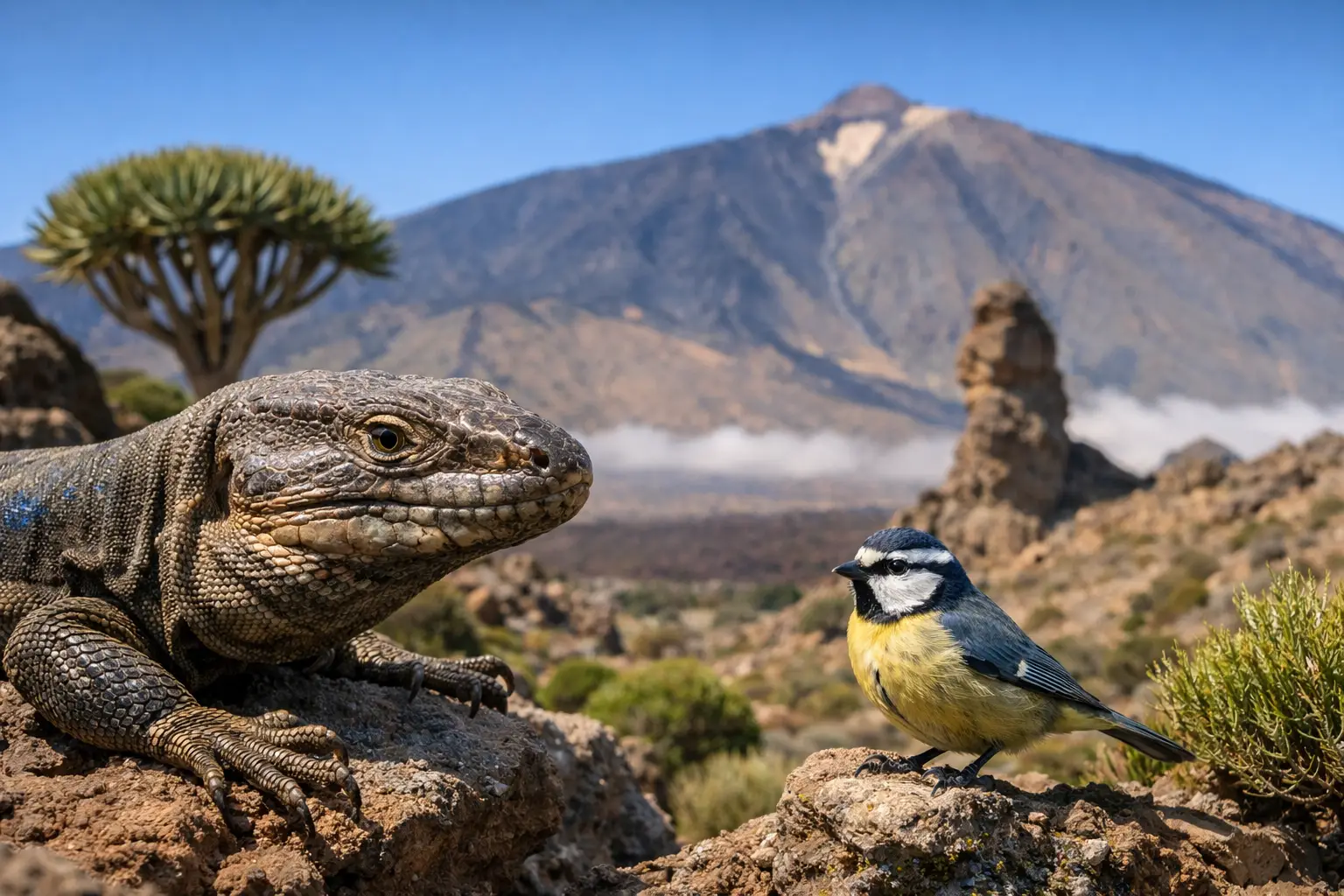
Reptiles offer some of the clearest examples of unusual island evolution in the Canary Islands. The archipelago is home to the endemic lizard genus Gallotia, and fossil and historical evidence shows that some Canarian lizards reached considerably larger sizes than many of the species visible today.
The Tenerife giant lizard, Gallotia intermedia, is one of the surviving examples. Its restricted distribution and protected status reflect the wider vulnerability of endemic island reptiles. Other islands have their own distinctive Gallotia lineages, shaped by long periods of separation and different local environments.
| Species | Island | Status / significance | Ecological role |
|---|---|---|---|
| Gallotia goliath | Tenerife | Extinct; historically reached very large proportions | Herbivore / seed disperser |
| Gallotia simonyi | El Hierro | Critically Endangered; El Hierro giant lizard | Omnivore / herbivore |
| Gallotia intermedia | Tenerife | Critically Endangered; Tenerife giant lizard | Cliff-dwelling herbivore |
| Gallotia stehlini | Gran Canaria | Gran Canaria giant lizard | Omnivore |
Large body size can provide advantages in an island environment. A bigger animal may be able to exploit a wider range of food or cope with competition more effectively. For herbivorous reptiles, body size can also influence how efficiently plant material is processed.
But being large is not automatically beneficial. A larger body requires more energy, and that becomes a disadvantage when drought, habitat loss or declining food supplies put pressure on a population. Evolution does not work towards greater size; it favours traits that improve survival and reproduction under particular conditions.
The history of the giant lizards also illustrates how quickly island ecosystems can change. Human settlement brought new pressures through hunting, habitat transformation and introduced animals. Some distinctive island species declined or disappeared before their biology was fully understood.
Island dwarfism is often discussed in connection with large mammals that evolved smaller bodies on relatively small islands. The Canary Islands have a different evolutionary record from the Mediterranean islands famous for dwarf elephants, but the underlying principle remains useful: limited resources can favour smaller, more efficient bodies.
Small landmasses have finite carrying capacity. Seasonal rainfall can make food unpredictable, while steep volcanic ravines and fragmented vegetation can restrict movement between suitable habitats. Under such conditions, a smaller body may reduce daily energy requirements and make scarce resources go further.
For island birds, reptiles and mammals, evolutionary change does not necessarily produce an obvious miniature version of a mainland animal. It may appear instead as differences in body mass, limb proportions, feeding structures, diet or reproductive timing.
The fossil record of the Canary Islands also reveals extinct endemic mammals, including large native rodents such as Canariomys bravoi from Tenerife and Canariomys tamarani from Gran Canaria. Their remains show that the modern wildlife of the islands represents only part of a much longer evolutionary history.
The expression "island laboratory" is useful, provided it is not taken too literally. The Canary Islands remain connected to the wider world by winds, ocean currents and migrating animals. Today, ships and aircraft provide additional pathways for species to arrive.
Climate change has also repeatedly altered island environments over geological time. Changes in sea level, vegetation and temperature can affect how populations spread and interact. Volcanic eruptions add another layer, creating new terrain, destroying existing habitats and forcing organisms to recolonise altered landscapes.
The age of each island matters as well. Older islands have had longer periods in which populations could diverge and specialise, while newly formed volcanic terrain begins the process of colonisation again. Tenerife illustrates this variation particularly well, from its dry southern coast to the high-altitude environments around Mount Teide.
For wildlife, these changes mean that evolution is an ongoing process rather than a finished story. A population may begin to diverge in isolation and later encounter a new competitor, climate condition or habitat change that alters its trajectory.
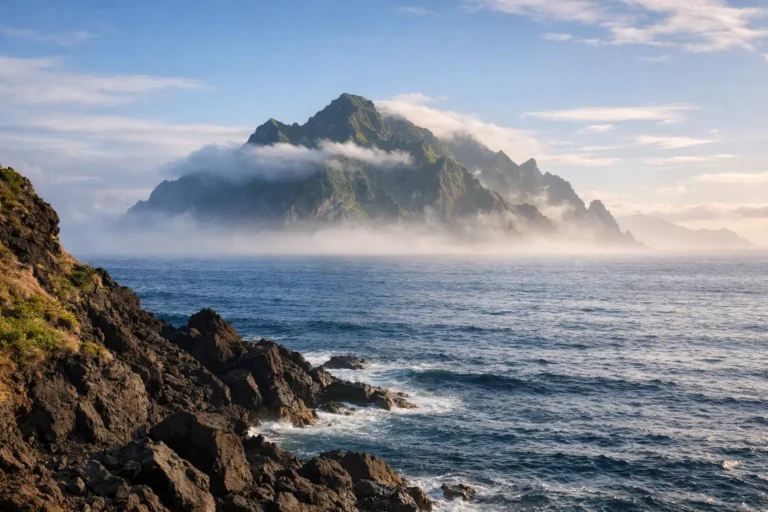
Understanding island gigantism and dwarfism changes the way the landscape can be read. The cliffs above the Atlantic, dry coastal scrub, volcanic ravines and higher mountain zones are not simply different scenery. Each represents a different set of environmental pressures that has influenced the plants and animals living there.
From the water, these contrasts can be especially easy to appreciate. A cruise along the southern coast reveals steep volcanic formations, sheltered coves and changing vegetation rising inland. Behind the coastline is an island where life has repeatedly adapted to isolation.
For guests heading out on a private yacht, the marine environment provides another perspective on the same idea. A private whale and relaxation cruise can bring the coastline and Atlantic ecosystem into the same experience, while wildlife sightings remain dependent on natural conditions rather than a guaranteed schedule.
The conservation lesson is equally important. Endemic species exist within relatively limited habitats, so disturbances can have effects that are disproportionate to their size. Visitors can help by keeping a respectful distance from wildlife, avoiding feeding animals, staying on marked paths and choosing operators that follow responsible wildlife-observation practices.
The giant lizards of the past, the endemic species that survive today and the animals that disappeared after human settlement are all parts of the same story. Island evolution is shaped by isolation, opportunity and limitation, while human activity can alter that balance surprisingly quickly.
Next time you look across Tenerife's volcanic slopes or watch a bird cross the Atlantic horizon, there is another layer to the landscape worth remembering. The Canary Islands are the product of geological forces, but they are also places where living species have spent thousands and millions of years adapting to the particular conditions of island life.
Island gigantism occurs when an animal evolves to become larger than its mainland relatives. Changes in predator pressure, competition, food resources and available ecological niches can all contribute to this pattern over many generations.
Island dwarfism is the reverse pattern, in which larger animals evolve smaller bodies over time. Limited food and space can favour reduced body size because smaller animals generally require less energy to survive.
Several large lizard forms evolved across the Canary Islands, including the Tenerife giant lizard (Gallotia intermedia). Fossil and historical evidence also points to giant lizards that were considerably larger than many species seen in the archipelago today.
Island species can evolve without predators, competitors or diseases that are common elsewhere. When new species or environmental pressures arrive, endemic populations may therefore have limited defences and can decline rapidly.
Yes. Several large Gallotia species survive in the archipelago, although some are highly threatened. The Tenerife giant lizard (Gallotia intermedia) and El Hierro giant lizard (Gallotia simonyi) are among the best-known examples.
Keep a respectful distance from wildlife, never feed wild animals, stay on marked paths when exploring on land and choose marine-tour operators that follow responsible wildlife-observation practices.