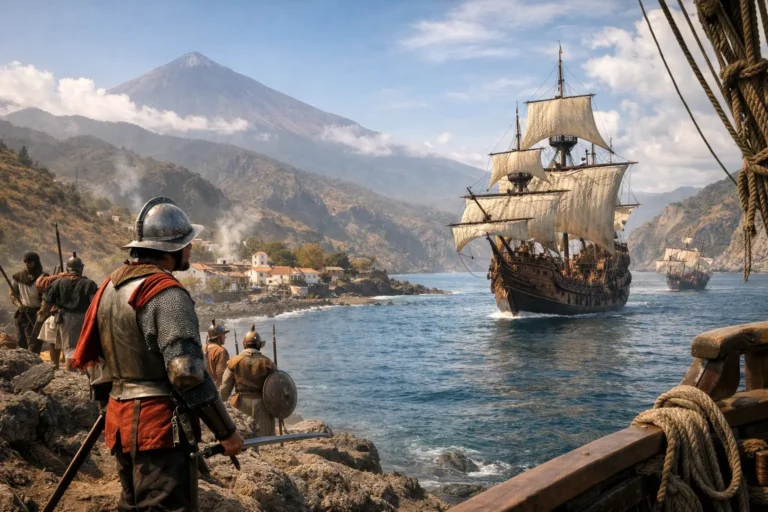
A glance from Tenerife's southern coast towards the open Atlantic gives a sense of the decision once facing European navigators: ahead lay weeks of ocean, uncertain winds and shores that were still poorly understood by Europeans. The Canary Islands' role in the Age of Discovery was shaped by this geography. Positioned off the north-west coast of Africa, the archipelago became a vital stopping point for ships sailing west from Iberia, providing supplies and access to the wind systems that made transatlantic voyages possible.
For visitors enjoying Tenerife's volcanic coastline and open waters today, this history adds another dimension to the landscape. The Canary Islands were not simply a remote boundary of the known world. They became a strategic meeting point where ships, sailors, merchants and explorers prepared for journeys that would transform global trade, politics and cultures.

The Canary Islands occupied an exceptionally useful position for ships leaving the Iberian Peninsula. Vessels could travel south towards the Canaries and then take advantage of the prevailing north-east trade winds for the westward crossing of the Atlantic.
For sailors working with relatively slow ships and limited navigational technology, predictable wind patterns were crucial. A direct westward departure from northern Europe was considerably less attractive than reaching latitudes where established wind systems could assist the crossing.
The islands also provided something every long-distance expedition needed: a final opportunity to prepare before losing sight of land. Ships could take on fresh water and food, carry out repairs, organise provisions and make sure the crew and vessel were ready for an extended ocean passage.
The importance of individual islands changed over time and depended on the expedition. Gran Canaria developed an important port at Las Palmas, while San Sebastián de La Gomera became closely associated with Atlantic voyages. Tenerife, dominated by the unmistakable peak of Mount Teide, provided one of the most recognisable natural landmarks in the eastern Atlantic.
The expression "Age of Discovery" can make this period sound like a straightforward story of explorers sailing into unknown waters. The historical reality was considerably more complex.
European voyages created new routes, expanded geographical knowledge and connected distant markets. At the same time, they enabled conquest, forced labour, resource extraction and the disruption of Indigenous societies. The Canary Islands themselves were part of this process rather than being distant observers of it.
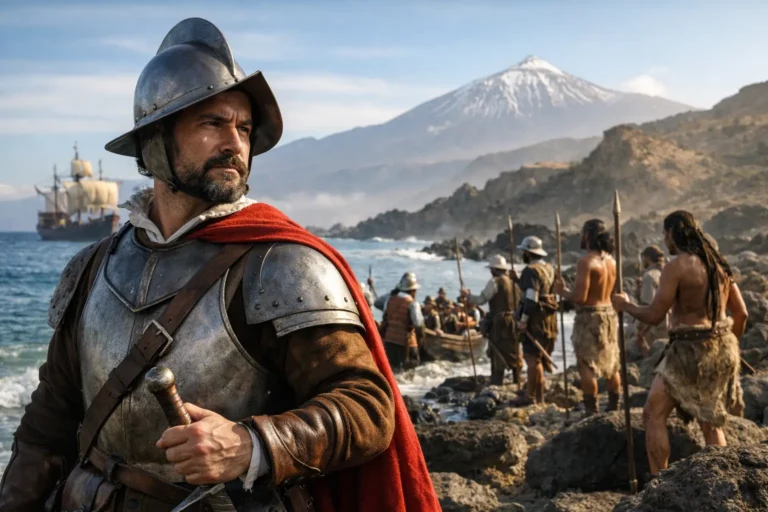
Before Castilian conquest, the archipelago was home to Indigenous communities with distinct traditions on the different islands. The conquest of Tenerife, completed in 1496 under Alonso Fernández de Lugo, brought the island into the Crown of Castile and fundamentally changed its political, social and economic structure.
Land was redistributed, Christianity was imposed, and new agricultural and commercial systems developed. Sugar cultivation became particularly important and was connected to wider patterns of labour and commerce across the Atlantic.
In the centuries that followed, people, crops, livestock, skills and cultural traditions moved between the Canary Islands and the Americas. The archipelago therefore became part of the human and economic network created by Atlantic expansion.
Christopher Columbus's connection with the Canary Islands is one of the best-known episodes in the archipelago's maritime history. His fleet stopped in the islands before beginning the westward crossing in 1492, making use of the archipelago to prepare for the Atlantic voyage.
The expedition consisted of the Santa María, Pinta and Niña. The Pinta required repairs during the stopover, and the fleet took on provisions before continuing west. La Gomera is particularly associated with the final preparations before the Atlantic crossing.
Some details of Columbus's stay are presented differently in historical and popular accounts, so it is better to avoid turning every detail into a certainty. What is clear is the strategic importance of the Canaries: they provided the last European landfall before Columbus's fleet entered the open Atlantic on its way towards the Caribbean.
The significance of that departure became much greater after the voyage. Subsequent expeditions followed Atlantic routes through the Canaries, making the islands increasingly familiar to sailors, merchants, missionaries and settlers travelling between Europe and the Americas.
The success of early Atlantic navigation depended heavily on understanding the sea itself. The north-east trade winds generally carried ships westwards from the Canaries towards the Caribbean. For the return journey, sailors used changing wind patterns and the broader circulation of the North Atlantic to work their way northwards and then east towards Europe.
This did not make the Atlantic easy to cross. Early navigators had no satellite forecasts, electronic charts or reliable engines. They depended on celestial observations, dead reckoning, experience and knowledge accumulated by generations of sailors.
The islands themselves were useful navigational references. Tenerife's volcanic profile, dominated by Mount Teide, could be recognised from far offshore under suitable conditions. Coastal topography, wind changes and cloud formations around the mountains also provided information to experienced pilots.
The ability to combine these natural signals with knowledge of prevailing winds gradually turned the Atlantic from an enormous barrier into a navigable, repeatable route.
As Atlantic voyages became more frequent, the Canary Islands developed an economy increasingly connected to maritime trade. Ships required pilots, shipwrights, storage, provisions, sails, rope and other supplies. Ports became places where commercial activity and maritime logistics came together.
Agriculture also adapted to this new economy. Sugar became an important early export, while wine later emerged as one of the islands' best-known products. Canarian wine developed markets in Europe and across the Atlantic, demonstrating how the routes established during the period of early expansion continued to influence the islands long afterwards.
But prosperity also brought vulnerability. The wealth and shipping associated with the islands attracted privateers, corsairs and rival European powers. Ports and coastal settlements therefore required defensive structures and military planning.
Francis Drake's unsuccessful attack on Las Palmas in 1595 is one example of the continuing struggle over Atlantic routes. By this point, the Canaries were firmly established as part of a maritime network whose importance extended far beyond the islands themselves.
It is tempting to view the Age of Discovery entirely through the achievements of navigation. The history of the Canary Islands shows why that perspective is incomplete.
The conquest of the islands involved military campaigns, alliances, resistance, population loss, forced conversion and the reorganisation of land and labour. The experience of Indigenous communities formed part of a broader pattern that would later be repeated on a much larger scale in the Americas.
The islands consequently occupy an unusual place in Atlantic history. They were both a destination of European conquest and a launch point for further expansion. Their ports helped connect continents, while the social and economic changes taking place on the islands became part of the same Atlantic transformation.
Understanding this context gives the term "Age of Discovery" greater depth. These voyages were remarkable achievements of navigation, but they also produced consequences that lasted for centuries.
Tenerife's relationship with the ocean remains visible everywhere along its coast. The island's volcanic peaks, prevailing winds and deep Atlantic waters still shape how people move around the archipelago, even though modern navigation has removed many of the uncertainties faced by earlier sailors.
From the water, the historical geography becomes particularly easy to appreciate. Looking back at Tenerife's steep coastline, it becomes clear why prominent volcanic landmarks were useful to sailors and why sheltered ports were so valuable to ships preparing for an ocean crossing.
A modern cruise is, of course, a completely different experience from a sixteenth-century Atlantic voyage. There are no weeks of uncertain navigation ahead and no need to carry months of provisions. Instead, guests can enjoy the same broad ocean from the comfort of a modern yacht, with the coastline and neighbouring islands providing a living connection to the maritime past.
For those who want to experience Tenerife from the sea, a private yacht charter offers the freedom to explore the coastline at your own pace. A whale-watching tour adds another perspective on the Atlantic, where modern visitors can encounter marine life in waters that once formed part of Europe's great ocean routes.
For an evening on the water, a private sunset cruise offers perhaps the most atmospheric way to look back towards Tenerife as the light fades over the volcanic landscape.
The contrast is striking. The same trade winds that once helped uncertain sailing ships begin their journey west now carry the evening breeze across a modern yacht. The same volcanic silhouette that helped sailors identify Tenerife from offshore remains on the horizon. The technology and purpose have changed, but the Atlantic connection remains.
The role of the Canary Islands in the Age of Discovery is ultimately a story about geography. The islands were in the right place, at the right latitude, to become a crucial part of the emerging Atlantic world.
Their importance came from much more than their position on a map. The Canaries provided ports, provisions, local knowledge and access to the winds that made westward crossings more practical. Over time, they became part of a much larger network linking Europe, Africa and the Americas.
Today, seeing Tenerife from the water offers a quiet way to understand that history. Look towards the coastline and the outline of La Gomera, feel the Atlantic breeze and consider how different that same horizon must have appeared to sailors preparing to leave Europe with no certainty about what lay ahead.
The ocean has not changed its scale. Our ability to cross it has.
The Canary Islands offered a strategically located stopping point for ships crossing the Atlantic. Vessels could take on water and food, carry out repairs and prepare their crews before using the prevailing north-east trade winds to travel west towards the Caribbean and the Americas.
Columbus's fleet stopped in the Canary Islands before beginning the westward Atlantic crossing in 1492. The expedition used the islands to prepare for the voyage, and La Gomera is particularly associated with the final stage of those preparations before the fleet sailed towards the Caribbean.
The north-east trade winds generally carried sailing vessels westwards from the Canary Islands towards the Caribbean. For the return journey, sailors used changing wind patterns and the broader circulation of the North Atlantic to travel northwards and then east towards Europe.
Tenerife was the last of the Canary Islands to be conquered by the Crown of Castile. The campaign led by Alonso Fernández de Lugo concluded in 1496, bringing the island under Castilian control and beginning a profound transformation of its political, social and economic life.
After the Castilian conquest, the islands became increasingly integrated into Atlantic commerce. Ports supplied ships crossing the ocean, while agricultural products such as sugar and later wine became important exports. People, crops, skills and cultural traditions also moved between the Canaries and the Americas.
Yes. A yacht cruise offers a different perspective on Tenerife's coastline and its strategic geography. From offshore, volcanic landmarks, coastal formations and neighbouring islands help illustrate why the Canaries were so important to historic Atlantic navigation.