The Alonso de Lugo conquest of Tenerife was not a single victorious landing, nor a simple footnote beneath the island’s beautiful beaches and Atlantic views. It was a hard-fought military campaign that changed Tenerife permanently, bringing devastating losses for its Indigenous Guanche communities and laying the foundations of the colonial society that followed. For visitors sailing along Tenerife’s coast today, understanding this history adds depth to the cliffs, valleys, and harbours that make the island so compelling.
Before Castilian forces arrived, Tenerife was inhabited by the Guanches, the Indigenous people of the Canary Islands who are ethnically and linguistically linked to North African Berbers. They lived in a society adapted closely to the island’s dramatic volcanic geography, raising goats and sheep, cultivating land where conditions allowed, and using natural caves and stone dwellings across the steep slopes and ravines.
The island was divided into nine distinct territories, known as menceyatos, each governed by a king or chief called a mencey. These territories did not act as a unified political block. This division proved critical when the Castilian campaign began, as some menceyes chose strategic alliance or accommodation with the invaders (known as the bandos de paz), while others led a determined defense of their sovereignty (the bandos de guerra).
The island’s landscape was central to Guanche defense strategies. Tenerife’s steep barrancos (ravines), dense laurel woodlands, and sharp changes in altitude were familiar territory for local fighters, but proved demanding and treacherous for heavily armed soldiers arriving from mainland Spain. The contrast remains easy to appreciate from the water: the coast may appear open, yet the land rises quickly into formidable mountain terrain.
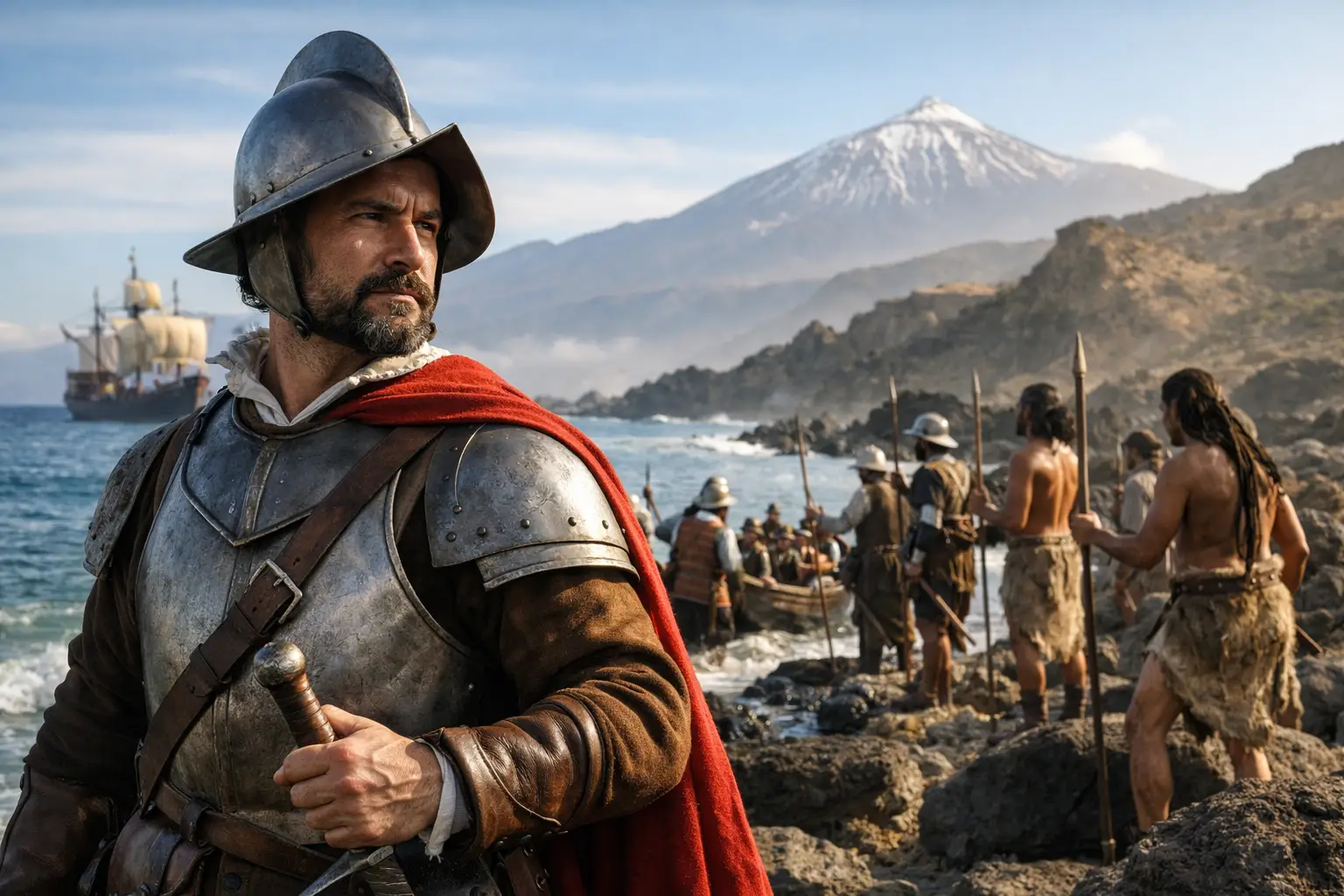
Alonso Fernández de Lugo was a Castilian military leader and administrator who had already participated in the conquest of Gran Canaria and successfully led the conquest of La Palma. In 1494, backed by financial support from the Crown of Castile and private commercial financiers, he organized an expedition to subdue Tenerife, the last major stronghold outside Castilian control.
His initial campaign landed near the modern-day capital of Santa Cruz de Tenerife in May 1494. Lugo established a base camp and secured peace pacts with the southern and eastern menceyatos, including Güímar, Adeje, Abona, and Anaga. However, the northern territories—most notably Taoro, under the leadership of Mencey Bencomo—flatly rejected Castilian authority and prepared for war.
The invading force combined professional soldiers, European settlers, and native contingents from already-conquered islands. They deployed horses, steel swords, crossbows, and early firearms (arquebuses). The Guanche defenders relied on wooden spears (añepas), sharpened stones, and superior mobility. Weaponry alone did not guarantee success when the invading army moved through restricted, hostile terrain.
The first major clash occurred in May 1494 in the northern ravine of Acentejo. As Lugo’s troops advanced blindly into the interior toward the valley of Taoro, Guanche warriors launched a massive ambush from the slopes. The Castilian forces, restricted by their heavy armor and unable to use their cavalry effectively in the narrow terrain, suffered a catastrophic defeat.
Historical accounts indicate that nearly 80% of the Castilian force was killed in the engagement. Lugo himself was wounded and narrowly escaped back to the coast, subsequently evacuating his remaining troops to Gran Canaria. This crushing defeat is preserved in the name of the modern municipality where the battle took place: La Matanza de Acentejo ("The Slaughter of Acentejo").
Alonso de Lugo refused to abandon the enterprise. He sold his properties and secured fresh financial backing from Italian and Castilian merchants, returning to Tenerife in late 1495 with a larger, highly disciplined army that included veterans of the Granada War.
This second invasion benefited from enhanced logistical support and reinforced alliances with the friendly Guanche factions. Furthermore, the Indigenous resistance had been severely weakened by an epidemic known in historical records as the modorra tinerfeña. Most modern epidemiologists and historians believe this was an introduced disease, such as smallpox, influenza, or typhus, to which the isolated Guanche population lacked immunity. The resulting loss of life heavily depleted the ranks of the resisting warriors.
| Battle Name | Date | Outcome | Historical Significance |
|---|---|---|---|
| First Battle of Acentejo | May 1494 | Decisive Guanche Victory | Decimated Lugo's initial army, forcing a complete temporary retreat from the island. |
| Battle of Aguere | November 1495 | Castilian Victory | Fought on the plains of La Laguna; resulted in the death of resistance leader Mencey Bencomo. |
| Second Battle of Acentejo | December 1495 | Decisive Castilian Victory | Overwhelmed the remaining northern resistance using superior firepower and cavalry tactics. |
Following the second defeat at Acentejo—commemorated today by the town of La Victoria de Acentejo—organized military opposition collapsed. The final chapter of the conquest concluded on July 25, 1496, with the signing of the Treaty of Los Realejos. The remaining northern menceyes officially surrendered to Lugo. Rather than submit to foreign rule, Bentor, the son and successor of Bencomo, tragically threw himself from the cliffs of Tigaiga.
Following the conclusion of the campaign, Alonso de Lugo was appointed Adelantado (military governor) of the Canary Islands. The structural changes implemented under his administration fundamentally remade the island:
The Guanche population did not vanish entirely. Modern genetic studies reveal significant Indigenous maternal ancestry among today's Canarian population, and their heritage endures in local place names, wrestling traditions (lucha canaria), agricultural techniques, and culinary staples like gofio.
For modern travelers enjoying a yacht cruise or whale watching in Tenerife along the southern coast, the rugged topography provides clear insight into why this conquest was so protracted. Looking inland from the Atlantic, the rapid elevation changes, towering cliffs, and deep ravines illustrate the immense defensive advantages held by the Guanches.
While today's visitors associate the island with leisure, every maritime approach historically represented a strategic choice concerning access to resources and defensible terrain. To experience the fullness of Tenerife's heritage, time spent on the water is best paired with journeys into the northern interior to see the historic streets of La Laguna or the dramatic landscapes of the Acentejo region.
The conquest began with the landing of Alonso Fernández de Lugo in May 1494 and formally ended with the surrender of the Guanche kings on July 25, 1496.
The Castilian forces were ambushed in a narrow ravine by Guanche warriors led by Mencey Bencomo. The steep, restricted terrain prevented the Spanish from effectively using their cavalry and firearms, resulting in a total tactical disaster.
While many Guanches died from warfare and introduced European diseases (the modorra), and others were unlawfully enslaved, the surviving population gradually assimilated into the new Castilian society. Their genetic and cultural lineage remains an important component of modern Canarian identity.
Founded by Alonso de Lugo in 1496, La Laguna was the island's first capital. Its innovative unfortified grid system served as a direct architectural blueprint for Spanish colonial cities across the Americas, leading to its designation as a UNESCO World Heritage site.