Before the first dolphin breaks the surface, there is often a different kind of spectacle above the water: a shearwater banking low over the Atlantic, its wings barely clearing the swell. The waters off Costa Adeje and Los Cristianos are best known for whales and dolphins, but they also attract a surprising variety of marine and coastal birds.
Birdlife changes with the season, weather and distance from shore. Nothing in nature should be treated as guaranteed, but a yacht gives you a good opportunity to notice birds that are easy to miss from land. With open deck space and a clear view in several directions, you can watch the birds' flight rather than simply wait for them to appear in front of you.
Seabirds are built for movement. They appear without warning, use the wind with remarkable precision and can disappear over the horizon within seconds. From a yacht, you have a much wider field of view than from a busy beach or harbour, making it easier to follow a bird's flight across the water.
An elevated viewpoint from the open deck or flybridge can also help when birds are gliding close to the surface. Instead of watching one fixed section of coastline, you can scan the horizon, the water around the boat and the sky above it.
The pace of a yacht trip matters too. When you are able to sit comfortably outside and watch the water for a while, you are more likely to notice a bird passing in the distance or following a particular patch of sea.
On a private whale and relaxation cruise, the route can also be adapted to the conditions and the interests of your group, while wildlife remains the priority rather than following a rigid sightseeing schedule.
For many guests, Cory's shearwater is the most memorable seabird seen from a yacht in Tenerife. It is a large, long-winged bird with a pale body and a distinctive gliding flight. Rather than constantly flapping, it can travel considerable distances by using the wind above the waves.
The Canary Islands are an important area for these birds, particularly during their breeding season. They are often associated with the warmer months, although timing and local conditions can vary.
A Cory's shearwater may travel alone or in a loose group, sometimes following areas where fish are present. When one crosses the yacht's path, its low, sweeping flight can be much more impressive in person than it appears in a photograph.
It is also worth remembering that the bird is not there for the boat. The best encounter is one in which the yacht continues steadily and the bird chooses to cross your path naturally.
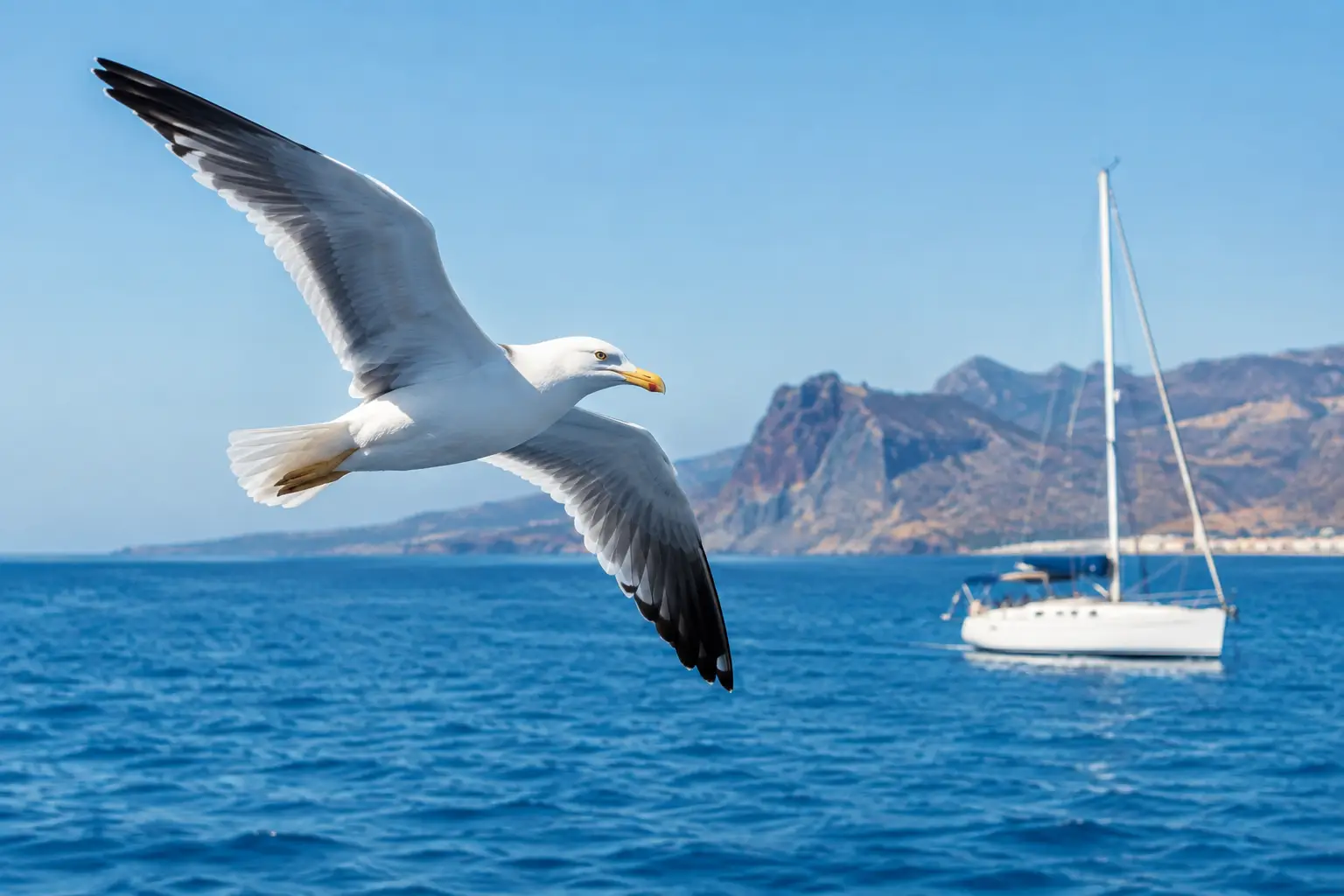
Yellow-legged gulls are among the most familiar birds around Tenerife's marinas, beaches and rocky coastline. They are particularly easy to spot around harbour areas and coastal towns, including the southern resorts.
They may not be as unusual as a pelagic seabird, but they are an interesting part of the transition from land to open ocean. As a yacht leaves the harbour, the familiar gulls gradually give way to birds more closely associated with offshore waters.
Gulls can be curious around boats, which makes good onboard practice important. Do not throw food overboard to attract them. Feeding changes natural behaviour and encourages birds to approach vessels unnecessarily closely.
Terns are more slender than gulls, with pointed wings and a light, fast flight. Depending on the season, you may see them travelling along the coast, hovering briefly over the water or diving towards fish below the surface.
Migration influences which species appear around Tenerife and when. Spring and autumn can bring passage birds moving between different parts of the Atlantic and nearby continents, although sightings are naturally less predictable than those of resident species.
Closer to shore, observant passengers may also notice waders, herons or egrets around quieter sections of coastline. These birds are more closely associated with land and shallow water, but they can add another layer to a coastal cruise.
Some of the most interesting seabirds are also the easiest to miss. Bulwer's petrels, storm petrels and smaller shearwaters spend much of their lives at sea. They are relatively small, fast and can disappear against the changing surface of the Atlantic.
Identifying them from a moving yacht can be difficult. Light, distance, viewing angle and sea conditions can all affect what you see. A brief dark shape skimming the surface may be exciting even when you cannot confidently put a species name to it.
That is part of the appeal of marine birdwatching. The goal does not have to be identifying every bird. Sometimes the most memorable sight is simply watching how a particular species uses the wind and waves.
Time of day can make a noticeable difference to the experience. Early morning cruises often bring softer light, cooler air and less glare on the water, which can make birds easier to see.
Sunset offers a completely different atmosphere. The warm light can be excellent for photography, and a shearwater crossing the horizon against the evening sky can make a memorable scene.
Season matters too. Some birds are associated with particular parts of the year, while others can be seen more regularly around the coast. Weather and sea conditions also influence what is visible on any particular day.
A moderate breeze can make gliding birds particularly interesting to watch, while stronger wind can make it harder to scan the surface. If the Atlantic becomes lively, the skipper may choose a more protected route rather than taking the yacht farther offshore purely in search of a possible sighting.
The best wildlife encounters feel unforced. If a bird is nearby, allow it to decide where it goes rather than trying to make the yacht approach it.
The same principle applies to whales and dolphins. A responsible wildlife experience gives animals space to choose their own direction and distance rather than turning an encounter into a pursuit.
For photography, behaviour can be more interesting than a perfect portrait: a shearwater banking into the wind, a tern hovering before a dive or a gull framed against Tenerife's volcanic coastline can tell a better story than a tightly cropped image.
Marine birds are also useful reminders that the surface of the ocean is connected to everything happening below it. A group of birds concentrating in one area can sometimes indicate fish near the surface. Flying fish, seabirds and marine mammals may all be responding to the same underlying availability of food.
That makes a yacht trip interesting even when the headline wildlife does not appear. The coastline, ocean surface, birds and marine mammals are all parts of the same environment.
And because birds can appear at any moment, keeping an eye on the horizon can add an unexpected dimension to a day that might otherwise be focused entirely on whales, dolphins or swimming.
Whales and dolphins may be the main reason many visitors go out on the water, but seabirds can become some of the most memorable details of the journey. A shearwater gliding beside the yacht, a tern diving into the sea or a bird briefly crossing the horizon can transform an ordinary stretch of open water into something worth watching closely.
If you are taking a private sunset cruise, the changing light can make these encounters particularly photogenic. On a daytime private yacht charter, there is more time to observe the coastline and open water from different perspectives.
Bring sunglasses, sun protection and a light layer for the breeze. Most importantly, look up as well as out. The next wingbeat over the Atlantic may be one of the most unexpected moments of your time on the water.
Cory's shearwaters are among the most memorable seabirds you may see over the Atlantic. Yellow-legged gulls are common around marinas and the coast, while terns and other passage birds may appear depending on the season. Bulwer's petrels, storm petrels and other pelagic species are possible but more difficult to identify.
Early morning often offers softer light, less glare and cooler air. Sunset provides warm light for photography. Season also matters because migration affects which birds may be present, while weather and sea conditions influence what can actually be seen on a particular day.
The Canary Islands are an important area for Cory's shearwaters, particularly during their breeding season. They are often associated with the warmer months, although timing and local conditions vary.
No. Feeding seabirds can change their natural behaviour and encourage them to approach boats too closely. It is better to let birds choose their own distance and observe them without attracting them.
Yes. A camera or phone with some zoom is useful because birds can remain at a distance. For the best results, watch for behaviour such as gliding, hovering and diving rather than trying to get as close as possible. Keep your camera ready, but remember to enjoy the encounter without viewing everything through the screen.