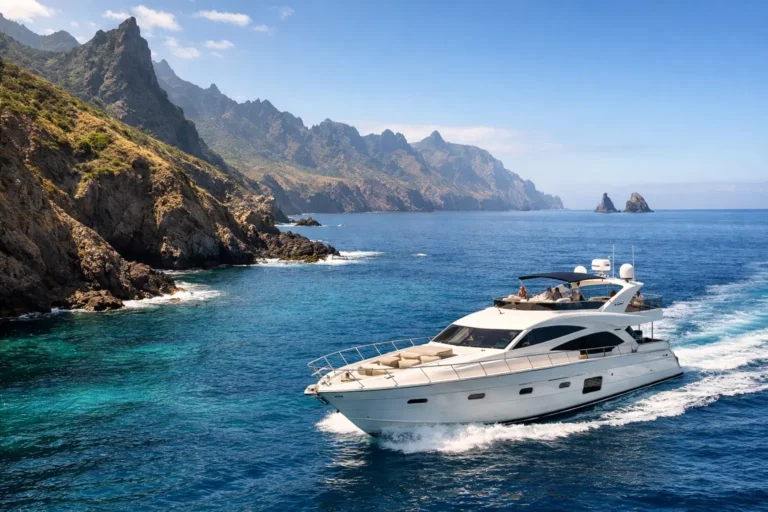
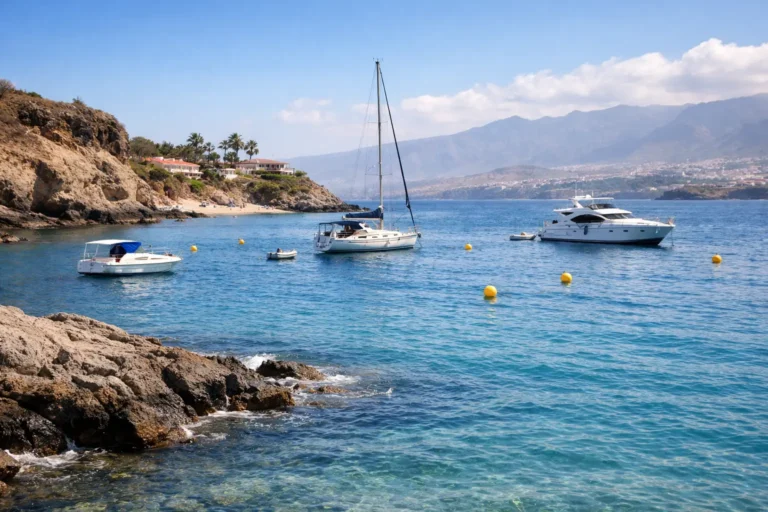
The first sight of Los Gigantes is difficult to appreciate fully from photographs. From the water, the cliffs rise so abruptly from the Atlantic that their scale becomes clear only as a yacht draws closer. Seeing Los Gigantes from the sea reveals a changing coastline of volcanic walls, hidden coves, marine life and open-ocean views that are difficult to experience from land.
For visitors staying in Costa Adeje, Los Cristianos or elsewhere in the south of Tenerife, a yacht trip offers a completely different perspective on this famous part of the island. The coastline unfolds gradually as you approach, with the cliffs becoming larger and more detailed with every kilometre.
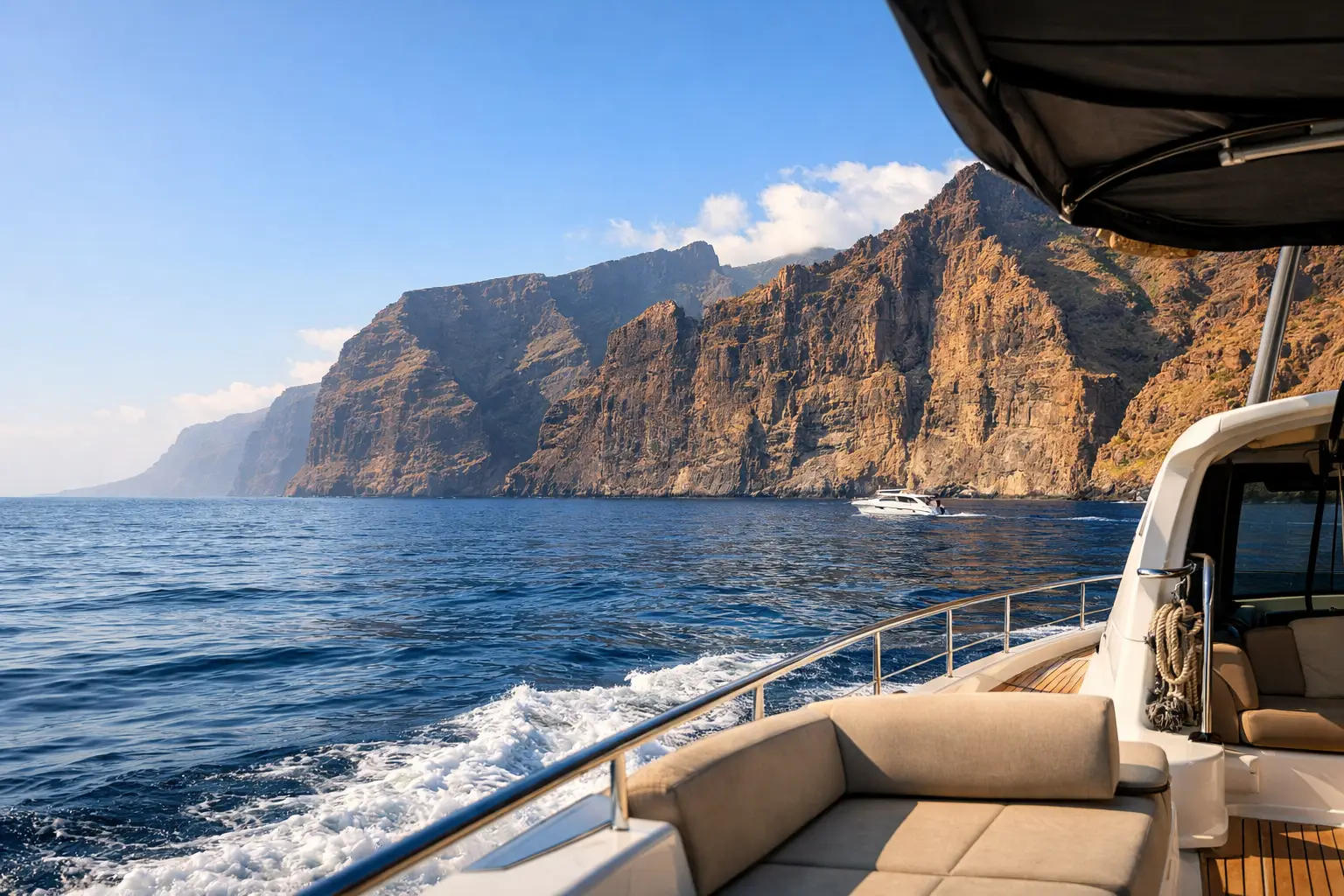
Los Gigantes means “The Giants”, and the name becomes easy to understand at sea. The basalt cliffs reach heights of up to around 600 metres in places, forming a dramatic wall along Tenerife's western coast.
From land, you usually see the cliffs framed by roads, buildings or viewpoints. From a yacht, the perspective changes completely. The rock faces rise directly from the ocean, with nothing between you and the volcanic landscape.
The colour is another detail that is easy to miss in photographs. The cliffs are not uniformly black. Depending on the light, their volcanic surfaces can show charcoal, brown, rust and greenish tones, while weathered rock layers create lighter bands across the faces.
Late-afternoon light can make the cliffs particularly striking. Lower sunlight creates longer shadows and warmer tones, giving the rock faces a more sculpted appearance.
The Los Gigantes coastline is not a single uninterrupted wall. As you travel along it, the cliffs reveal folds in the volcanic landscape, rocky inlets and small coves that are difficult or impossible to appreciate from the road.
Some sections are best viewed from a respectful distance, particularly when there is Atlantic swell. Depending on the route and conditions, there may also be an opportunity to stop for a swim in a suitable sheltered area.
This is one of the main differences between seeing Los Gigantes from land and travelling along the coast by yacht. The landscape changes continuously as you move through the water rather than remaining a fixed view from a single lookout.
A yacht gives you a low, water-level perspective of the cliffs while also allowing you to look across the wider Atlantic. You can notice details that are easy to miss from shore: seabirds moving along the cliff line, small ledges high above the water and the constantly changing texture of the rock.
Looking away from the cliffs, the horizon opens out. On clear days, La Gomera may be visible in the distance, adding another dimension to the landscape and reminding you that Tenerife is part of a much larger Atlantic setting.
The waters off Tenerife's south-west coast are known for resident short-finned pilot whales and several dolphin species. This means that a journey towards Los Gigantes can combine coastal scenery with the possibility of seeing marine wildlife.
However, sightings are never guaranteed. Whales and dolphins are free-ranging animals, and their location and behaviour can change with weather, sea conditions and feeding patterns.
If cetaceans do appear, you might see pilot whales travelling together at the surface or dolphins moving through the water alongside the yacht. A responsible crew observes them without pursuing or pressuring the animals and maintains an appropriate distance.
The combination of wildlife and scenery is part of what makes this section of the coast particularly interesting. You can be watching a group of cetaceans one moment and then find yourself looking up at hundreds of metres of volcanic cliff the next.
The cliffs naturally dominate the view, but they are not the only things worth watching. Seabirds often follow the coastline, and flying fish may occasionally break the surface in warmer conditions.
The colour of the Atlantic also changes as you move between deeper water and more sheltered coastal areas. Depending on the light and sea conditions, the water can range from deep cobalt blue to lighter shades closer to shore.
There is also a noticeable change in the character of Tenerife itself. As the yacht moves away from the busier southern resorts, the built-up coastline gradually gives way to the rugged western landscape. The volcanic character of the island becomes much more apparent from the sea.
The cliffs look completely different as the sun gets lower. Their faces become darker and more defined, while the sea can take on silver, orange and golden tones.
As the yacht turns back towards the south, the lights of the coastline gradually begin to appear. For photographers, this creates a very different atmosphere from a daytime visit, while for everyone else it is simply another way of experiencing the cliffs.
Weather and visibility determine how dramatic the sunset will be on any particular day, so the exact view is always changing.
The type of trip matters because Los Gigantes is part of a longer coastal experience rather than a single viewpoint. A shared excursion can be a practical way to spend time on the water, while a private charter offers more flexibility for the group.
Royal Ocean's Private Whales & Relax Cruise combines coastal cruising with the possibility of whale and dolphin watching, swimming and time to enjoy the scenery. The route can be adapted to the conditions and the interests of the group.
For celebrations and special occasions, the Special Events on a Yacht experience can also be tailored around the group's plans, subject to sea and weather conditions.
Whatever type of cruise you choose, practical details make a difference on a day at sea. Shade, comfortable seating, space to move around the deck and a crew familiar with the local coastline all contribute to the experience.
If swimming is possible on your route, bring swimwear and a towel. Sunscreen and sunglasses are important even when the day feels mild, while a light layer can be useful for the return journey when the yacht is moving against the breeze.
A camera is worth bringing, but it is also worth leaving some time to simply watch the cliffs. The scale of Los Gigantes is difficult to capture in a single photograph, particularly when you are close to the rock face and looking upwards from the water.
It is also best to leave rigid expectations behind. The exact route, sea conditions, wildlife activity and possibility of swimming depend on the day. A good crew adapts the trip to the conditions rather than forcing the itinerary.
The basalt cliffs of Los Gigantes reach heights of up to around 600 metres in places. Their scale is particularly striking from the water, where the rock faces rise directly from the Atlantic.
Yes. There are viewpoints and roads from which you can see the cliffs, but a yacht provides a different perspective. From the sea, you can see the coastline at water level and discover coves, inlets and details that are difficult to appreciate from land.
Whales and dolphins may be encountered in the waters around Tenerife, including resident short-finned pilot whales and several dolphin species. Sightings are never guaranteed, however, and responsible operators allow wildlife to determine the encounter.
Depending on the route, sea state and local conditions, a yacht trip may include a swim stop in a suitable sheltered area. The skipper will assess the conditions and choose an appropriate location.
Bring swimwear and a towel if swimming is possible, as well as sunscreen, sunglasses and a light layer for the breeze. Comfortable clothing is useful, particularly if you are spending several hours on the water.