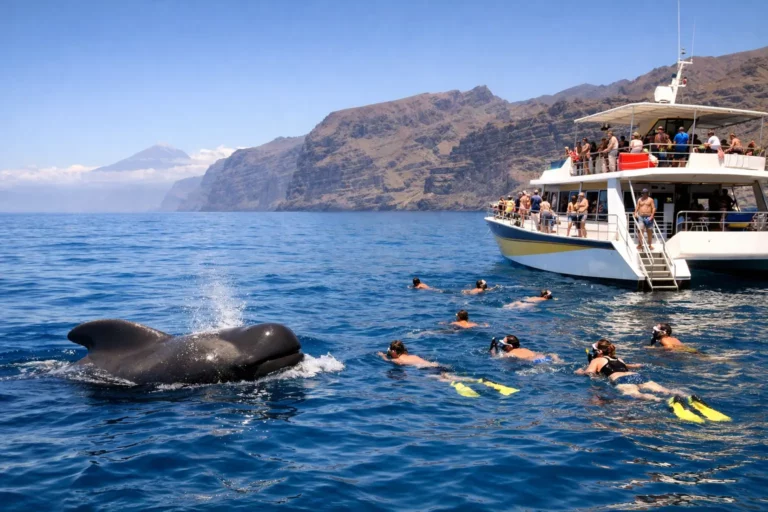
The ocean off south Tenerife can appear beautifully empty from the marina, then reveal a pod of pilot whales resting calmly beyond the coast. So, how do yacht crews find whales and dolphins around Tenerife? It is not a matter of racing out and hoping for the best. It comes down to local knowledge, careful observation, favourable sea conditions and a respectful approach that puts the animals first.
For guests, that means the experience feels effortless: a relaxed cruise from the south of the island, attentive service on board, and the thrilling moment wildlife appears in its natural setting. Behind that calm experience is a crew reading the water, the weather and years of patterns on this remarkable stretch of Atlantic coastline.
Tenerife’s south-west coast is one of Europe’s most rewarding places to look for cetaceans. The deep waters close to shore, along with the island’s volcanic underwater landscape, create favourable conditions for a variety of species throughout much of the year.
Short-finned pilot whales are among the best-known residents of these waters. They are often seen in family groups and may rest, travel or socialise near the surface. Bottlenose dolphins are also regularly encountered, while common dolphins, Atlantic spotted dolphins and other visitors may appear depending on the season, food availability and sea conditions.
That does not make every trip identical. Wildlife is never booked to a timetable, and that uncertainty is part of what makes an encounter so memorable. A professional crew plans around the conditions and the area’s established wildlife patterns, while allowing the day’s natural rhythm to lead the route.
Before departure, the crew checks the forecast with a practical focus on wind direction, swell, visibility and cloud cover. A bright, calm morning can make a whale’s dark dorsal fin easier to spot from a distance, while choppier water may conceal surface movement until a yacht is closer.
Conditions also influence where the most comfortable cruise will be. On a premium yacht experience, finding wildlife matters, but so does keeping guests relaxed. The best route balances the likelihood of sightings with sheltered cruising where possible, allowing everyone to enjoy the journey, refreshments and coastal views without an unnecessarily rough ride.
Experienced crews spend countless hours in the same waters. Over time, they learn the areas where pilot whales are frequently observed, how groups tend to move through particular channels, and which conditions make certain zones more productive than others.
This is knowledge built through regular time at sea rather than a single map point. Pods can shift, currents change and feeding opportunities move. A skilled skipper reads those changes and makes thoughtful decisions rather than treating wildlife watching as a formula.
The waters between Costa Adeje, La Caleta and Los Cristianos are particularly well known for sightings. Yet the precise location on any day may be different. Sometimes guests see cetaceans soon after leaving harbour; on other occasions, the crew cruises farther offshore while enjoying the open Atlantic and the outline of Tenerife’s dramatic coast.
Whales and dolphins do not always announce themselves with spectacular leaps. Often, the first clue is much quieter: a brief blow on the horizon, a change in the surface texture, a flash of a dorsal fin or a small group of seabirds working over fish.
Crew members scan continuously, looking across the water from different angles and using the yacht’s height to improve visibility. Dolphins may reveal themselves through quick, rhythmic movement or bow-riding behaviour, while pilot whales can be recognised by their measured surfacing and distinctive fins.
Patience is central to this work. The sea rewards a crew that stays alert without becoming hurried. Guests may be relaxing in the shaded seating area one moment, then quietly gathering at the rail as a pod surfaces nearby.
Licensed operators and professional crews working from Tenerife’s southern ports often have a strong awareness of current conditions and recent activity in the area. This can help a skipper make informed choices, but it should never mean a rush of boats converging on animals.
The best crews use information sensibly and independently. They remain focused on safe navigation, the comfort of their guests and the welfare of the cetaceans, rather than chasing every report across the water.
A meaningful sighting depends on what happens after the first fin is spotted. Whales and dolphins are wild animals, not part of a performance, and a luxury experience should feel calm for them as well as for the guests on board.
A considerate skipper approaches slowly, keeps an appropriate distance and avoids cutting across an animal’s direction of travel. If a pod changes course, rests, shows signs of discomfort or simply moves away, the yacht gives it space. Sudden acceleration, crowding and prolonged pursuit have no place in responsible wildlife watching.
Dolphins sometimes choose to approach a yacht and ride its bow wave. When that happens, it is an extraordinary sight, particularly from the open decks of a comfortable flybridge yacht. The distinction matters: the animals decide whether to come closer. The crew’s role is to operate predictably and respectfully, creating the conditions for a natural encounter rather than forcing one.
The crew takes care of the navigation and wildlife spotting, but a few simple choices can make the experience more enjoyable. Arrive ready for the water rather than the beach: a light layer is useful even on a warm day, as the breeze offshore can feel cooler. Polarised sunglasses can reduce glare and make it easier to notice movement on the surface.
Keep expectations open. One cruise may bring a close view of a resting pilot whale family; another may feature energetic dolphins playing in the wake. Occasionally, the most beautiful moments are the quieter ones: a glassy sea, the silhouette of La Gomera in the distance, and the sense of having stepped away from the busy resort shoreline.
Photography is welcome, but it is worth putting the camera down for part of the encounter. A steady mobile phone photograph or a long-lens image can be lovely, yet watching an animal surface with your own eyes often becomes the memory guests talk about long after their holiday.
For families, couples and groups celebrating something special, choosing a smaller, well-managed yacht also changes the feel of the day. There is more room to sit comfortably, ask the crew questions and enjoy the sighting without the noise and rush often associated with larger excursion vessels.
Whale and dolphin watching around Tenerife is possible year-round, but no responsible operator should promise a particular species, behaviour or distance from the yacht. Nature does not work to a script.
Calmer seas generally make spotting easier and are often more comfortable for guests who are unsure about motion sickness. Morning trips can offer softer light and quieter conditions, while later cruises add the atmosphere of the afternoon or sunset. The right choice depends on the forecast, the occasion and whether your priority is wildlife viewing, swimming, coastal scenery or a relaxed celebration on the water.
If weather conditions are unsuitable, a professional charter company will put safety first. That decision protects guests, crew and the marine environment, and it is part of the reassurance that comes with a carefully managed yacht experience.
The finest whale and dolphin experiences are not measured by how close a yacht can get. They are measured by the feeling of being welcomed into a wild place with care, comfort and respect.
On a refined cruise with Royal Ocean, the aim is to give guests time to enjoy that feeling properly: the quiet anticipation, the first sight of a fin, the shared excitement on deck and the peaceful journey home along Tenerife’s coast. Let the crew handle the search, settle into the comfort of the yacht, and leave room in the day for the Atlantic to surprise you.