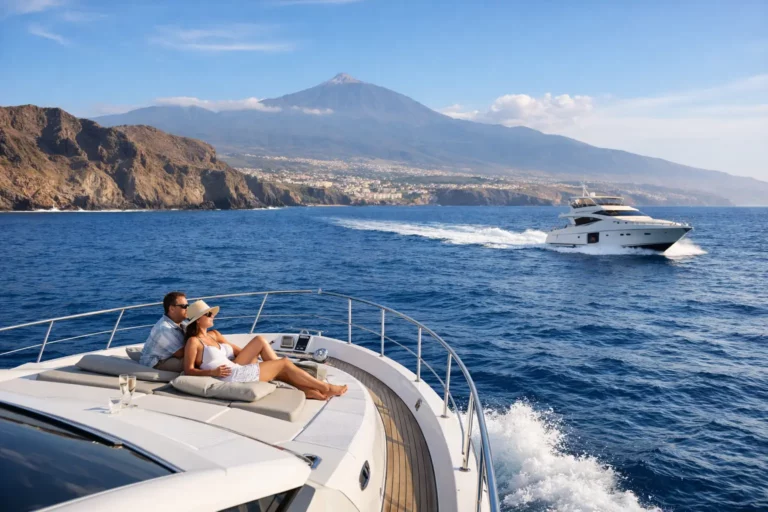
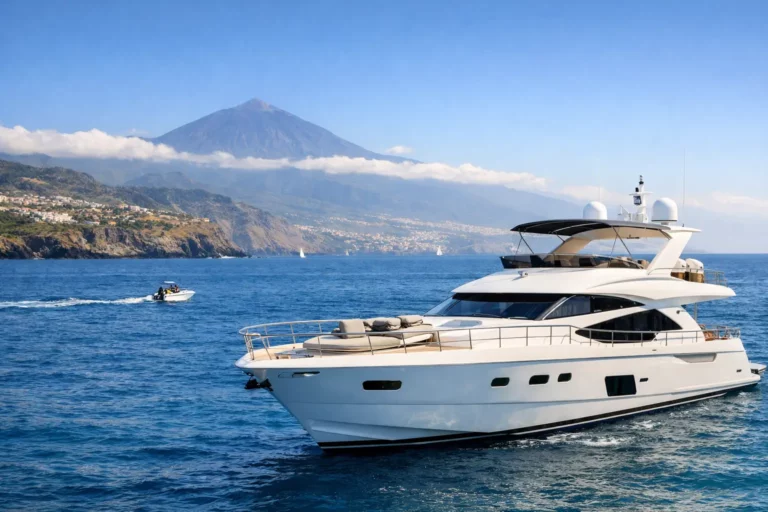
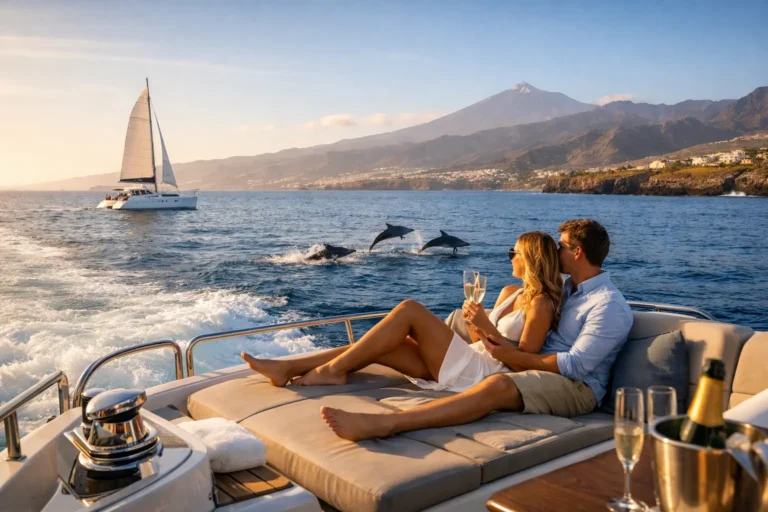
A calm, sunlit morning in Costa Adeje can still bring a graceful rise and fall to the Atlantic. So, what causes ocean swell around Tenerife? Waves, wind and distance are the essential answer, but the detail is what makes each day at sea feel different. The waves arriving beside Tenerife may have begun thousands of kilometres away, long before the island’s own skies turned blue.
For guests planning a refined cruise, understanding swell brings useful perspective. It explains why the sea can look beautifully orderly rather than flat, why the south coast often feels more sheltered, and why an experienced crew considers conditions as carefully as the route, refreshments and timing.
Ocean swell is a series of waves created by wind blowing over open water, usually far from the coast where you eventually encounter it. As wind transfers energy to the sea surface, small ripples become larger waves. Once they leave the storm or windy area that formed them, the waves can travel independently across the ocean as swell.
This is different from local wind chop. Chop is the shorter, less organised wave pattern made by wind blowing near the boat at that moment. It often feels sharper and more irregular. Swell tends to arrive in more even lines, with a gentle rhythm and a measurable gap between wave crests.
Tenerife sits in the Atlantic Ocean, exposed to wave energy generated across a vast area. That position makes the island a fascinating place to see how distant weather, local trade winds and volcanic geography combine.
The longer wind blows over the sea, and the greater the uninterrupted stretch of water it blows across, the more energy it can put into waves. Sailors and forecasters call that open-water distance fetch. A storm with a long fetch in the North Atlantic can create powerful swells that continue travelling towards the Canary Islands after the storm itself has weakened.
During that journey, the fastest and shortest waves lose energy first. The remaining swell becomes more ordered, often with longer periods. Wave period is the time between one crest and the next. A longer-period swell can look calm at first glance because the crests are widely spaced, yet it may carry considerable energy when it reaches a beach, harbour entrance or exposed headland.
That is why a bright, windless day in Tenerife does not automatically mean a flat sea. The local forecast describes what is happening nearby; the swell forecast also reflects what happened far out in the Atlantic days earlier.
Local wind still has an immediate influence on comfort at sea. Tenerife commonly experiences north-easterly trade winds, especially in the warmer months. When these winds strengthen, they can create surface chop on exposed waters, even if the underlying swell is modest.
Wind direction matters as much as wind strength. A breeze blowing from the land towards the sea may help keep nearshore water looking cleaner and more organised in some locations. Wind blowing directly onshore can build steeper, less comfortable waves close to the coast. Around an island with such varied contours, conditions can change noticeably between one bay and the next.
For a yacht cruise from south Tenerife, the southern coastline often benefits from greater protection than the north. This does not make the south coast immune to swell, particularly when Atlantic systems send waves from the south-west or west, but it does create many days of notably pleasant cruising.
Tenerife is not a low, flat island. Its dramatic volcanic profile, rising towards Mount Teide, affects the wind, while its headlands and coastline influence how waves arrive. The island can block or reduce wave energy on its sheltered side, a phenomenon often called an island shadow.
On the south-west coast, around Costa Adeje and Los Cristianos, this shelter is one reason the sea is frequently well suited to relaxed whale and dolphin watching, scenic sailing and swim stops. The water may still have a soft Atlantic motion, but it is often less exposed than beaches and ports facing north.
The protection is relative, not guaranteed. Swell can wrap around headlands, refract as it meets changing seabed depths, and enter bays from angles that are not obvious from the shore. A west or south-west swell, for example, may bring more movement to areas that are usually sheltered from north-easterly conditions.
As swell approaches shallower water, the lower part of each wave slows against the seabed while the top continues forward. The wave becomes steeper and can eventually break. This is why offshore conditions and beach conditions are not always the same. A gentle rolling swell offshore can produce impressive surf at an exposed beach.
The north coast faces the open North Atlantic more directly. In winter especially, it can receive significant swell from storms far to the north-west. These are the conditions that attract experienced surfers, but they can also make the sea look markedly more energetic.
The south and south-west are generally more protected, making them a preferred departure area for comfortable leisure cruises. However, the Atlantic is never a swimming pool. Conditions remain dependent on swell direction, period, wind, tide and the specific route planned for the day.
This variation is part of Tenerife’s appeal. It allows skilled crews to make thoughtful choices, seeking the most comfortable waters available rather than following a fixed route regardless of the weather.
Autumn and winter are typically the periods when larger North Atlantic swells are more likely. Powerful weather systems track across the ocean and can send long-period waves towards the Canaries. The weather in Tenerife itself may remain mild and inviting while the sea reflects activity from much further north.
Spring and summer often bring more settled swell patterns, though trade winds can be more noticeable. A moderate breeze can make the day feel wonderfully fresh on deck, but it may also add texture to the water. No season promises identical conditions every day, which is why a good marine forecast looks beyond a simple sunshine symbol.
Professional crews pay attention to several details: swell height, swell period, swell direction, local wind strength and direction, visibility, tidal timing and harbour conditions. None should be considered in isolation. A low swell height with a long period can deserve more attention than the number alone suggests, while a slightly higher but short, well-spaced swell may be perfectly manageable on a suitable route.
A little movement is a natural part of being on the Atlantic and, for many guests, part of the pleasure. A gentle swell gives a yacht that unhurried, floating rhythm that suits a glass of something chilled, a view along the coast and the anticipation of spotting pilot whales or dolphins.
Comfort depends on more than the forecast. Yacht design, speed, direction of travel, where guests sit and how the captain positions the vessel all matter. Travelling directly into chop can feel different from cruising across it or with it. An experienced captain can adjust pace and course to make the journey feel more composed, while choosing sheltered places where conditions allow for a swim stop.
If you are prone to seasickness, it is sensible to eat lightly beforehand, stay hydrated and spend time in the fresh air looking towards the horizon. Choosing a morning when the wind is lighter may help, but it is worth remembering that each forecast has its own pattern rather than a single perfect rule.
At Royal Ocean, the aim is always to pair Tenerife’s wild Atlantic beauty with the calm, attentive hospitality guests expect from a premium yacht experience. Conditions are assessed with care, because comfort and safety should feel considered rather than left to chance.
The sea around Tenerife is shaped by forces far beyond the horizon, yet that is exactly what gives every cruise its character. Ask about the day’s conditions before you depart, then let the crew guide you towards the most enjoyable water available - where the island, the light and the rolling Atlantic can be appreciated in complete comfort.