A glimpse of pilot whales resting in the glassy waters off Tenerife is one of those unforgettable holiday moments that naturally demands stillness. While terms like marine bioacoustics, anthropogenic noise, and cetacean conservation can sound strictly technical, the core issue comes down to a simple, ethical question: how can we enjoy an extraordinary encounter with marine life without disturbing the very creatures that make the experience possible?
For discerning travellers choosing a premium whale and dolphin watching experience, personal comfort and environmental care must go hand in hand. A meticulously maintained vessel, a knowledgeable crew, and an unhurried navigational approach create a far more refined day at sea—while drastically reducing the acoustic pressure placed on the resident cetacean populations of the Canary Islands.
The Atlantic ocean is far from silent. Whales and dolphins inhabit a world completely sculpted by sound, utilizing complex arrays of clicks, whistles, and social calls to navigate, locate prey, and maintain group cohesion. Short-finned pilot whales—resident along the deep marine shelf of south Tenerife—rely heavily on highly developed echolocation to hunt in total darkness thousands of meters below the surface.
The study of marine bioacoustics demonstrates that what we hear above the waterline represents only a fraction of the acoustic environment. Underwater, sound waves travel nearly five times faster than in air. An approaching motor vessel is heard by cetaceans long before its silhouette becomes visible, turning underwater propulsion noise into a major environmental factor.
Responsible marine tourism builds deep ocean stewardship, but execution is everything. Scientific studies highlight that chronic, unmanaged underwater engine noise can mask vital social signals and trigger avoidance behavior. Treating a wildlife sighting as a rare privilege rather than a high-speed chase preserves the natural tranquility of the ocean sanctuary.
Anthropogenic noise refers to any human-generated acoustic disturbance in the marine environment. Off the coast of Tenerife, this stems from commercial shipping, inter-island ferries, speedboats, and leisure charter fleets. Engine vibration, hull displacement, and underwater propeller rotation all contribute to the localized soundscape.
For cetaceans, sudden or aggressive engine noise interrupts resting patterns, forces unnecessary dive energy expenditure, and disrupts pod communication. Conservation in practice is not merely about enforcing boat count limits around a pod; it relies on the execution of eco-friendly seamanship: slowing down well outside the active wildlife zone, avoiding sudden throttle changes, and leaving animals an unobstructed path to move freely.
Professional crews should never surround, pursue, or cut across the swimming path of a pod. The most profound, breathtaking encounters happen when a vessel settles quietly at a respectful distance, allowing curious dolphins or resting pilot whales to choose if they wish to approach the hull naturally.
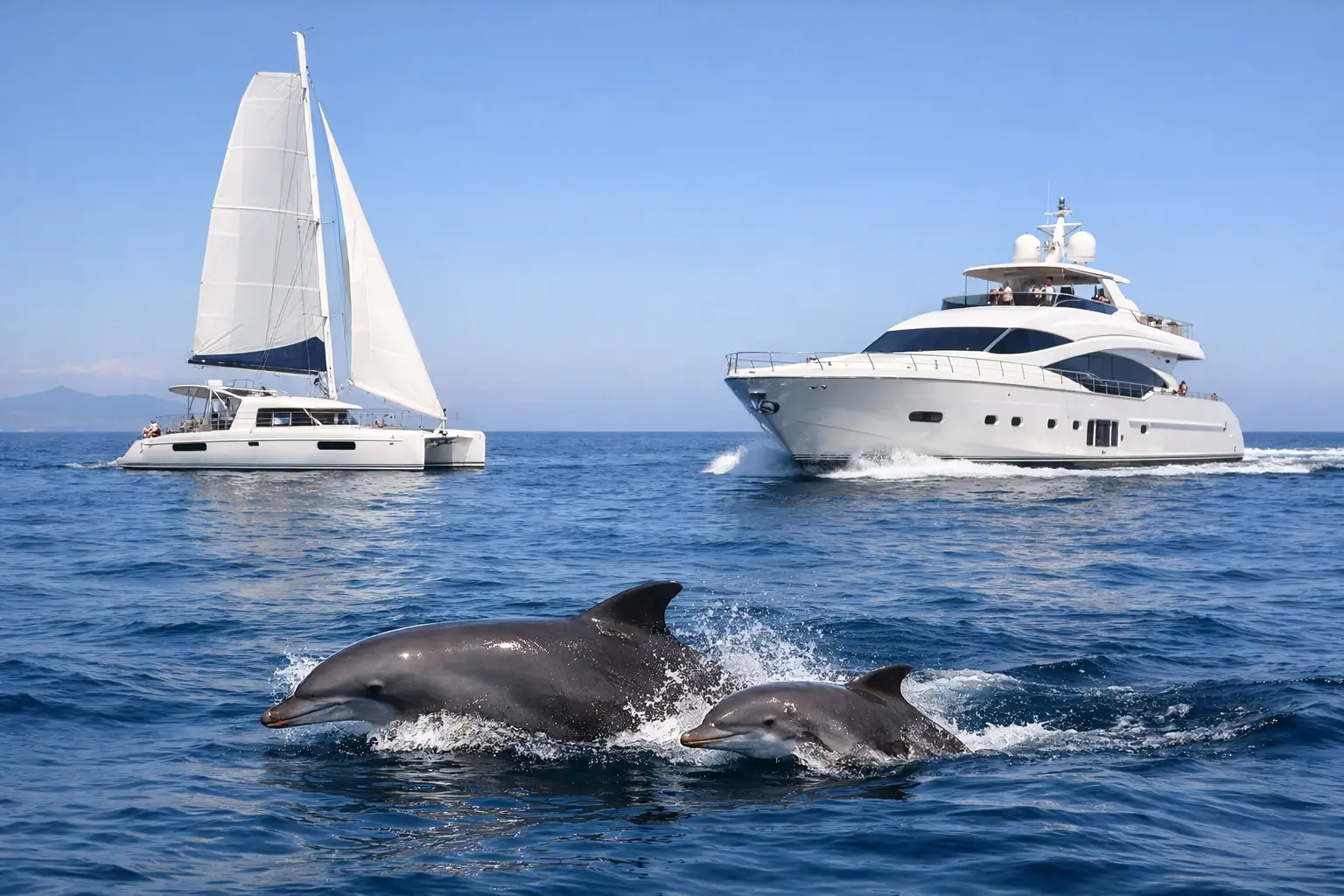
Travellers often ask whether a sailing catamaran or a luxury motor yacht is the quieter option for wildlife watching. The reality is that neither hull design is universally superior; acoustic impact depends almost entirely on engineering maintenance and captain operational discipline.
A catamaran's twin hulls provide exceptional lateral stability at anchor, reducing roll in open swells. However, catamarans utilize two separate engines and propulsion shafts. In choppy sea states, the flat bridge deck connecting the two hulls can generate persistent "hull slap"—a sudden, slapping impact against oncoming waves that transmits low-frequency shockwaves directly into the water column. Furthermore, large commercial catamarans carrying 80 to 100 guests introduce significant surface activity and crowd noise.
A high-tonnage motor yacht, operated at low RPMs, presents distinct acoustic advantages. Its deeper, single-displacement hull cuts smoothly through swells without slamming. When equipped with well-maintained underwater exhaust systems, insulated engine rooms, and precision-balanced propellers, a motor yacht glides through the water with a low, unobtrusive acoustic signature. Coupled with low passenger numbers, a private yacht provides a quiet, intimate platform for observing marine life without surface disturbance.
Several mechanical and operational details dictate a vessel's true impact on marine life:
When selecting a charter operator in south Tenerife, look beyond marketing photos of onboard catering. Seek out companies that prioritize ethical marine protocols, employ local maritime crews, and dedicate ample time to the voyage so that navigation never feels rushed.
Once on board, guest behavior plays a key role:
At Royal Ocean, the true luxury of a private or boutique shared charter extends beyond fine wine and spacious sun decks. It lies in the unhurried, mindful pace of the voyage itself. When the goal is an authentic connection with the Atlantic rather than a rushed photo opportunity, navigation becomes an art form.
This calm philosophy directly protects Tenerife's marine heritage. By keeping guest numbers strictly limited and operating our vessels with absolute respect, we ensure that pilot whales and bottlenose dolphins remain undisturbed in their natural sanctuary. The ultimate luxury at sea is the peace of mind that comes from enjoying paradise while leaving no trace behind.
Neither hull type is inherently better. Acoustic impact and guest comfort depend primarily on engine maintenance, propeller condition, passenger capacity, and the captain's navigation practices. A low-occupancy motor yacht operated at slow speeds can be just as quiet and respectful as a sailing catamaran.
Wild cetaceans are often curious, but high-speed approaches, excessive engine noise, or aggressive maneuvering will cause them to dive or alter their course. Responsible operators maintain a neutral position at a respectful distance, allowing animals to choose whether to approach.
Official Canary Islands regulations mandate a minimum safety distance of 60 meters from cetaceans. Vessels must also limit their speed to under 4 knots when within the 500-meter yellow zone and restrict observation time near a single group.
No. Swimming with, diving near, or touching wild cetaceans is strictly prohibited by law in the Canary Islands to protect the animals from stress, disease transmission, and physical injury.
Choose operators displaying the official Barco Azul (Blue Boat) flag, which certifies compliance with local environmental laws. Look for charter companies that limit passenger numbers, offer educational commentary, and prioritize sustainable marine practices.