A small silver flash skimming above the wake can stop even seasoned sea-watchers mid-conversation. Flying fish are one of the more unexpected sights in the open waters around Tenerife. They are seen less reliably than whales and dolphins, but when they appear, their movement is difficult to forget: a fish breaks the surface, accelerates across the water and suddenly seems to fly above the Atlantic.
For guests enjoying a yacht cruise from Costa Adeje or nearby ports, a flying fish sighting is an unscripted extra. It may last only a few seconds, but it offers a glimpse of a remarkable survival strategy shaped by life in the open ocean.
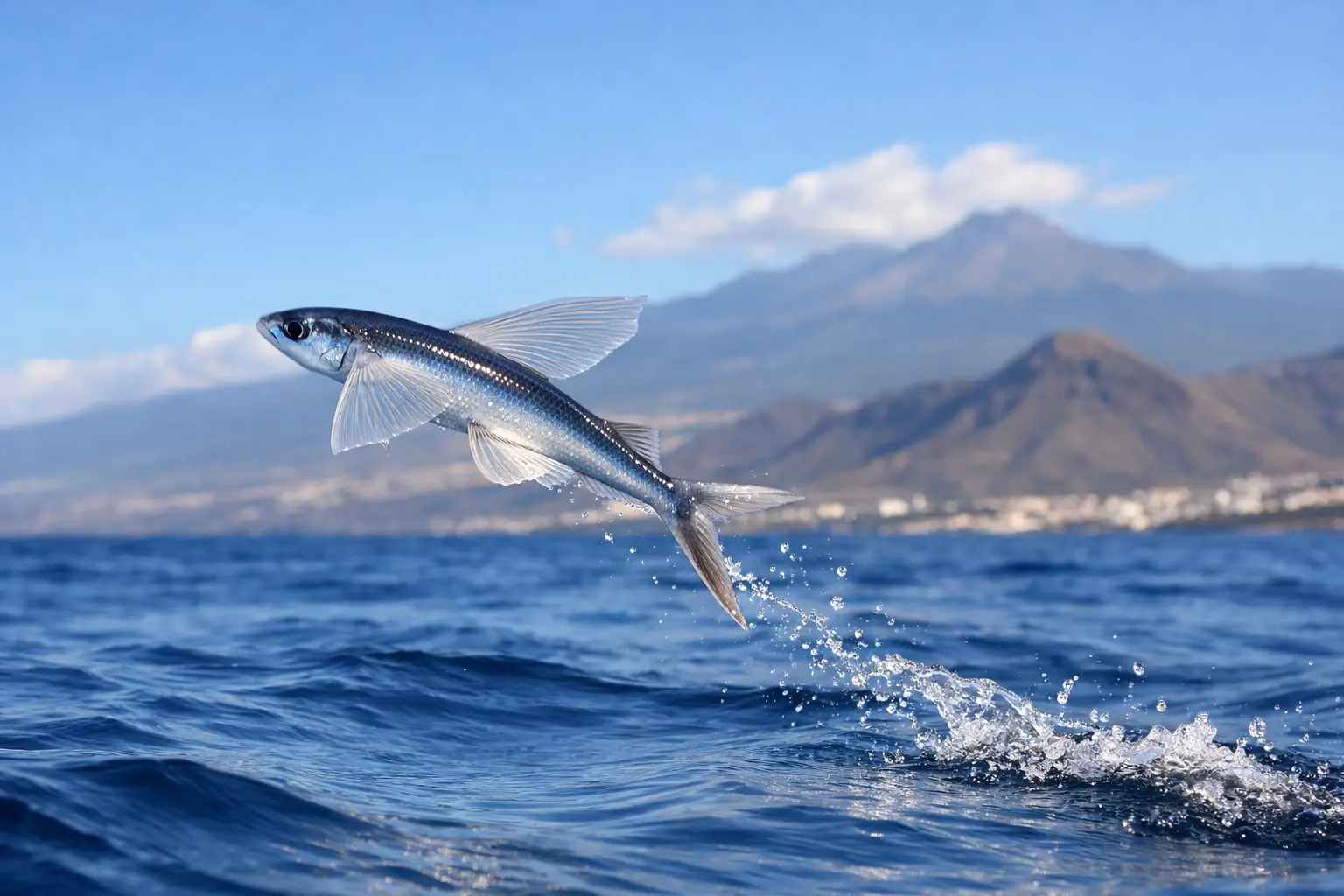
Flying fish belong to the family Exocoetidae, a group of marine fish adapted to escape predators by gliding above the sea. Despite their name, they do not fly in the same way as birds. Their fins do not beat to generate thrust in the air.
Instead, the fish creates speed underwater and converts that momentum into an aerial glide. Once it breaks the surface, its enlarged pectoral fins spread wide and act as lifting surfaces, allowing it to travel low above the water before returning to the sea.
This adaptation is particularly useful in pelagic habitats. In the open ocean, there are few places to hide. A fast predator can quickly pursue a small fish beneath the surface, but leaving the water changes the geometry of the chase and can create valuable distance.
From the deck of a yacht, the result can look almost unreal. A single silver fish may suddenly launch from the surface, or several may appear in quick succession, tracing low paths across the water before disappearing back into the Atlantic.
The process begins below the surface. A flying fish accelerates with rapid movements of its tail and approaches the surface at high speed. In many species, the lower lobe of the tail fin is particularly important during the final stages of acceleration.
As the fish reaches the surface, it may continue beating its tail against the water while part of its body is already out of the sea. This brief surface phase helps it maintain or increase speed before becoming fully airborne.
| Phase | What Happens | Purpose |
|---|---|---|
| Underwater acceleration | The fish generates speed through rapid tail movement. | Creates the momentum needed to leave the water. |
| Surface launch | The fish reaches the surface and may continue beating its tail against the water. | Provides the final acceleration before the glide. |
| Airborne glide | Large pectoral fins spread wide; some species also extend enlarged pelvic fins. | Generates lift and allows the fish to travel above the surface. |
| Touchdown and relaunch | The fish briefly contacts the water and can regain speed with its tail. | May allow the escape to continue without fully settling back into the sea. |
Some flying fish are often described as "two-winged", relying mainly on enlarged pectoral fins, while others also have enlarged pelvic fins that create an additional lifting surface. In both cases, the principle remains the same: underwater propulsion provides the energy, while the fins allow the fish to glide through the air.
The fish typically travels at a shallow angle rather than launching steeply upward. Staying close to the surface allows it to cover distance efficiently and, in favourable conditions, continue the glide through a sequence of brief contacts with the water.
The most widely recognised explanation for this extraordinary behaviour is predator avoidance. Flying fish live alongside fast pelagic predators, and the open ocean offers little physical cover.
By suddenly leaving the water, the fish can disrupt the pursuit and create separation from a predator approaching from below. The strategy is not without risk: once airborne, the fish may become visible to seabirds. But the ability to move quickly into a different environment can provide a crucial advantage during an escape.
For an observer, the behaviour looks elegant. For the fish, it is a rapid and highly specialised survival response.
A yacht does not need to chase wildlife for flying fish to become visible. As a vessel moves through open water, its bow wave and movement through the surface layer can disturb fish that are already close to the waterline.
A sudden disturbance may trigger an escape response, causing fish to accelerate away and glide above the surface. This is why guests sometimes notice them ahead of the yacht, alongside the hull or moving away from the wake.
Responsible observation is important. The purpose is never to pursue or deliberately disturb the fish. On a well-managed cruise, these moments happen naturally as part of travelling through the open Atlantic.
Tenerife's dramatic coastline is only one part of its marine environment. Beyond the beaches and sheltered bays lies the pelagic zone: the open water where currents, temperature, food availability and seasonal conditions influence what may be encountered on any given day.
Flying fish are part of this wider offshore ecosystem, alongside schooling fish, squid, turtles, seabirds and cetaceans. No two trips are identical. One day may bring dolphins in the distance; another may reveal seabirds following feeding activity, a turtle near the surface or a brief burst of flying fish ahead of the yacht.
The waters off south Tenerife are particularly interesting because deeper ocean waters lie relatively close to the coast. Guests can move from the busy shoreline into open Atlantic conditions without spending the entire cruise travelling offshore.
Flying fish are not the main attraction on most wildlife trips, and that is part of their appeal. Whale and dolphin encounters may last longer and be easier to observe, while a flying fish sighting can feel like a fleeting detail noticed only by those watching the water closely.
Flying fish may be present in Canary waters at different times of the year, but seeing them depends heavily on conditions. Sea state, light, visibility and the behaviour of the fish all influence whether a glide is noticed from the deck.
Calmer water generally makes sightings easier. A sudden splash or silver flash is much more visible against a smooth surface than among larger waves. In choppier conditions, flying fish may still be present but their low glides can disappear quickly among the movement of the sea.
The best approach is to keep an eye on the open water rather than focusing only on the coastline. Look ahead of the yacht and along the sides of the wake. A brief disturbance, a flash of reflected light or a small shape moving just above the surface may reveal a flying fish.
Morning and late-afternoon light can make the experience particularly atmospheric, while a sunset cruise offers a different perspective on the Atlantic altogether. Wildlife, however, remains unpredictable. The best experience comes from enjoying the full journey rather than waiting for one particular species to appear.
Some of the most memorable moments on a yacht are not part of the itinerary. They happen between destinations: a change in the light, a seabird passing overhead, dolphins appearing in the distance or a sudden line of silver fish escaping across the surface.
On a private charter, there is often more opportunity to notice these details. Couples, families and small groups can enjoy the journey at their own pace, with time to watch the coastline and the open water rather than simply moving from one scheduled activity to another.
Flying fish are especially difficult to photograph because they move quickly and without warning. Keeping a camera or phone ready and using continuous shooting can improve the chances of capturing the moment, but it is worth accepting that some sightings will remain better memories than photographs.
The next time the Atlantic appears calm and empty, keep watching. A small flash above the surface may reveal one of the ocean's most remarkable escape strategies.
Flying fish belong to the Exocoetidae family. They do not flap their fins like birds. Instead, they generate speed underwater with rapid tail movements, then spread their enlarged pectoral fins to glide above the surface. Some species also extend enlarged pelvic fins for additional lift.
Flying fish primarily leave the water to escape predators. Gliding allows them to quickly change the environment in which the chase takes place and create distance from fast predators beneath the surface. However, being airborne can also expose them to seabirds.
The distance varies between species and conditions. A single glide can cover tens of metres, and some flying fish can extend their overall journey by briefly touching the surface, regaining speed with their tail and launching again.
Flying fish are part of the pelagic marine environment around the Canary Islands, but they are much less predictable to observe than whales or dolphins. Sightings depend on conditions, location and the behaviour of the fish at that particular moment.
There is no guaranteed time or season for seeing flying fish during a yacht trip. Calm seas and good visibility generally make them easier to spot. Look ahead of the yacht and along the wake for sudden splashes, flashes of silver or low shapes gliding above the water.
Flying fish move quickly and appear without warning, so photography can be difficult. Keep a camera or phone ready and use continuous shooting if available. Always remain in a safe position on deck and avoid leaning over railings in an attempt to follow the fish.