A few miles from Tenerife's sunlit coast, the seabed can fall away with surprising speed. The deep waters around the Canary Islands are shaped by volcanic slopes, underwater ridges, channels and basins, creating an ocean environment that is very different from a typical shallow coastal area.
For guests setting out from south Tenerife, this underwater landscape helps explain the deep-blue horizon, the presence of resident pilot whales and the remarkable sense of scale that appears as soon as the coastline begins to recede.
The term "Canary Trench" is often used informally to describe the very deep waters and steep submarine terrain around the Canary Islands. It should not be understood as one neat, universally defined trench on every nautical chart. The underwater landscape is better described as a complex deep-ocean environment shaped by volcanic islands, submarine slopes, channels, ridges and deeper basins.
Tenerife rises from the Atlantic as a volcanic island, and its volcanic structure continues far below the surface. Instead of a broad, gently shelving seabed, parts of the surrounding ocean floor descend relatively quickly into deep water. In some areas around the Canary Islands, depths reach well beyond 1,000 metres.
This is one reason a yacht cruise in south Tenerife can feel so distinctive. A relatively short passage can take guests from sheltered coastal views to waters of remarkable depth. The cliffs, ravines and volcanic silhouette visible above the surface have equally dramatic counterparts beneath it.
Deep water is divided by scientists into several broad ecological zones. These zones are defined mainly by the amount of light that reaches them, and each supports a different community of organisms. The exact species found at any particular location vary considerably, but the general structure helps explain how much of the ocean exists beyond what we can see from a yacht.
| Oceanic Zone | Approximate Depth | Typical Conditions | What It Means for a Yacht Trip |
|---|---|---|---|
| Epipelagic | 0–200 m | Sunlight reaches the water; plankton, fish, dolphins and turtles may occur here | This is the part of the ocean visitors experience directly from the surface |
| Mesopelagic | 200–1,000 m | The twilight zone, with very little sunlight and many species adapted to low-light conditions | Invisible from the yacht, but important for the offshore food web |
| Bathypelagic | 1,000–4,000 m | Permanent darkness, cold water and high pressure | Illustrates how quickly Tenerife's surrounding ocean can transition into true deep-sea habitat |
The Canary Islands were formed by volcanic activity over millions of years. Successive eruptions built mountains from the ocean floor until they emerged as islands, while landslides, lava flows and sediment deposits continued to reshape the underwater slopes.
Deep-sea topography around Tenerife is therefore complex. There are steep submarine slopes, underwater ridges, sediment-covered areas and channels between the islands. The exact shape varies from one part of the archipelago to another.
For oceanographers, this terrain matters because underwater topography influences the movement and mixing of water. Currents encountering slopes and changes in depth can be redirected or mixed, affecting the distribution of nutrients and marine organisms.
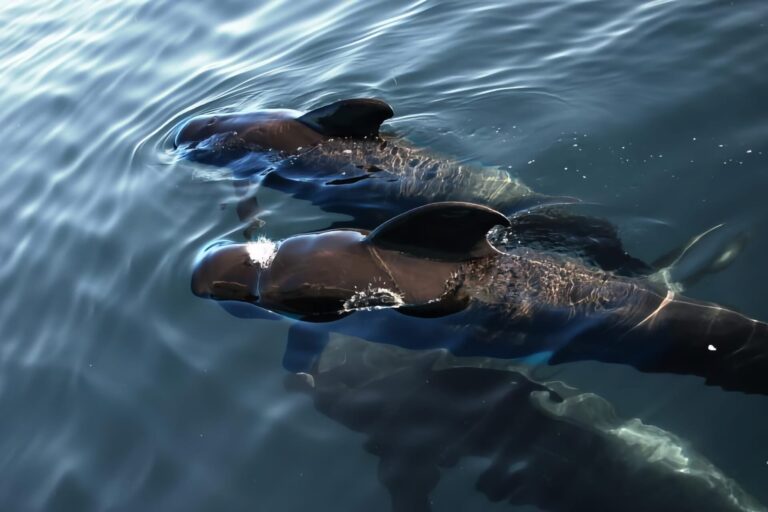
The waters off south Tenerife are particularly well known for short-finned pilot whales. Their presence is associated with the productive marine environment around the islands and with access to deep water where squid and fish are available.
Pilot whales are highly adapted to life in the open ocean and can dive to considerable depths in search of prey. Their feeding behaviour is therefore closely connected with the three-dimensional structure of the ocean rather than only with what can be seen from the surface.
This does not mean that every deep underwater contour automatically produces a wildlife encounter. Sea conditions, prey distribution and animal behaviour all change. The deep Atlantic environment simply provides an important part of the habitat that makes the waters around Tenerife so interesting for marine wildlife.
Dolphins may also appear during a cruise, sometimes travelling quickly through the area in small or larger groups. Their movements are more variable, which is why responsible wildlife watching should always be treated as an encounter with free-ranging animals rather than a guaranteed show.
On a private whale and dolphin charter from Las Galletas, the route can be adapted to the conditions and the interests of the group. The aim is to spend time on the water and observe the marine environment without chasing wildlife or turning the encounter into a spectacle.
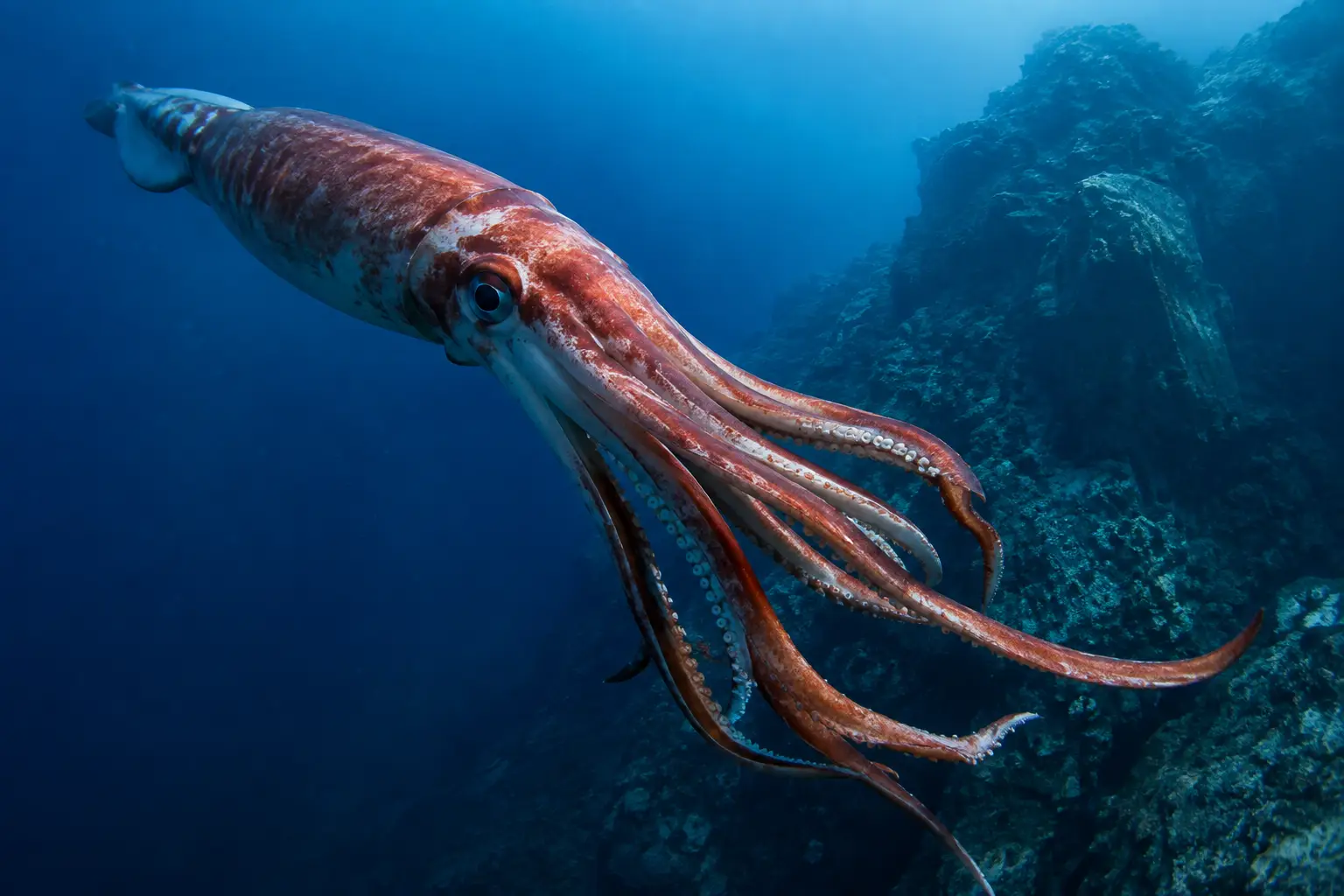
Giant squids occupy a special place in our understanding of the deep ocean. These animals belong to the genus Architeuthis and are among the largest known invertebrates. They live far below the bright surface waters, where darkness, pressure and the enormous size of the ocean make direct observation extremely difficult.
It would be misleading to suggest that giant squids are a regular sight around Tenerife or that they can be viewed from a boat tour. They cannot. Confirmed observations are exceptionally rare, and much of what scientists know about these animals has come from stranded specimens, deep-sea observations and scientific research.
Their existence is nevertheless a useful reminder of how little of the deep ocean we experience directly. The eastern Atlantic contains extensive deep-water habitats, while large predators such as sperm whales are known to make exceptionally deep dives in search of prey including squid.
More commonly, pilot whales and dolphins feed on smaller squid species. These animals are much more relevant to the marine food web that supports Tenerife's cetaceans. The giant squid remains an elusive symbol of the deep ocean rather than an expected part of a coastal cruise.
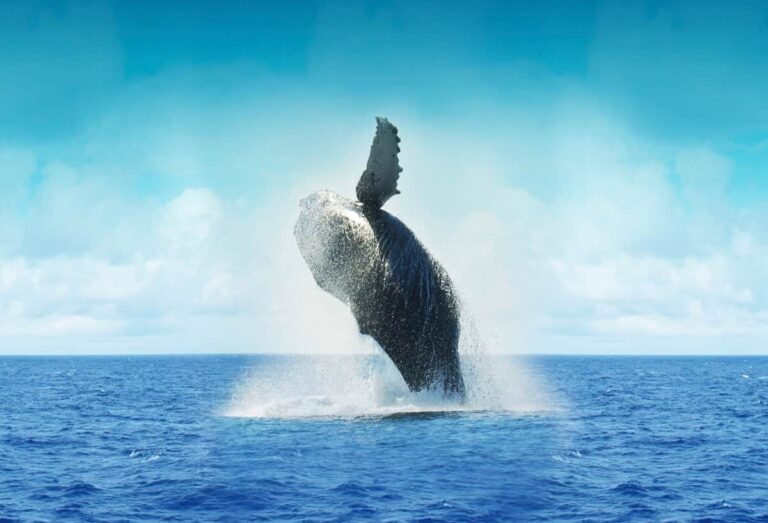
The most memorable marine experiences are often much closer to the surface. A pilot whale surfacing calmly beside the yacht, dolphins travelling through the area, flying fish flashing across the water or the changing colour of the Atlantic as Tenerife's coastline recedes can make the scale of the ocean surprisingly tangible.
Weather and light transform the setting throughout the day. In clear conditions, the sea may appear lighter near the coast and progressively deeper blue offshore. During a sunset cruise, the surface can take on completely different colours as the sun drops behind the horizon and La Gomera becomes a silhouette in the distance.
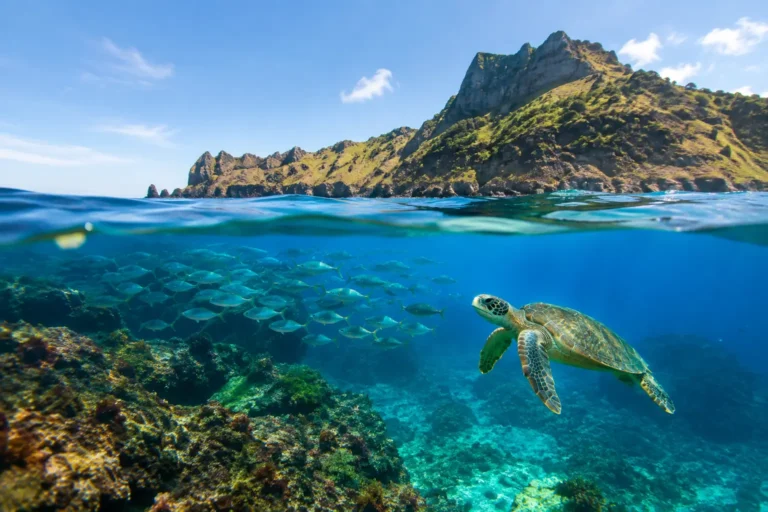
For guests who enjoy a swim stop, the contrast can be particularly striking. You may be floating in warm Atlantic water while knowing that the volcanic seabed below continues down into a much deeper underwater landscape.
Royal Ocean's private yacht charter combines time on the water with opportunities for wildlife watching, swimming and snorkelling, depending on the conditions and the chosen route.
Understanding the deep-sea environment adds another dimension to a whale-watching or yacht trip around Tenerife. The visible ocean surface is only the upper layer of a much larger system shaped by geology, currents, temperature, depth and marine life.
It also helps put wildlife encounters into perspective. Cetaceans need room to travel, feed and rest, and their behaviour should never be treated as something that can be controlled for visitors. Responsible observation means keeping an appropriate distance, avoiding unnecessary disturbance and allowing the animals to decide how close they come.
A smaller, well-managed excursion can make this approach easier. Guests have more space to observe, listen to the crew and appreciate the surroundings without feeling that every moment has to produce a photograph or a sighting.
For a shared experience, the shared whale-watching excursion from Las Galletas offers another way to explore these waters, with wildlife observation and a swim stop included when conditions allow.
The next time Tenerife's coastline slips behind the stern, look beyond the surface. Beneath the calm Atlantic blue lies a volcanic underwater landscape of extraordinary scale, and every whale or dolphin sighting offers a small glimpse into the much larger ecosystem below.
The term "Canary Trench" is often used informally to describe the very deep waters and steep submarine terrain around the Canary Islands. It is not one universally defined trench on every nautical chart, but rather a wider deep-ocean setting shaped by volcanic islands, submarine slopes, channels, ridges and deeper basins.
Parts of the seabed around the Canary Islands descend quickly into deep water. In some areas around the archipelago, depths reach well beyond 1,000 metres. Tenerife's volcanic slopes continue far below the surface, creating dramatic underwater contours.
Giant squids of the genus Architeuthis are associated with deep ocean habitats, and the eastern Atlantic contains suitable deep-water environments. However, confirmed observations are exceptionally rare. A giant squid encounter cannot be expected on a Tenerife boat tour.
Short-finned pilot whales are regularly present in the waters around Tenerife. Their presence is associated with the area's favourable marine conditions, available prey and access to deep water. They are adapted to diving and feeding on squid and fish at depth.
Pilot whales, dolphins and flying fish are among the marine animals that may be seen from the surface. Sea conditions and animal behaviour vary, so wildlife sightings are never guaranteed.