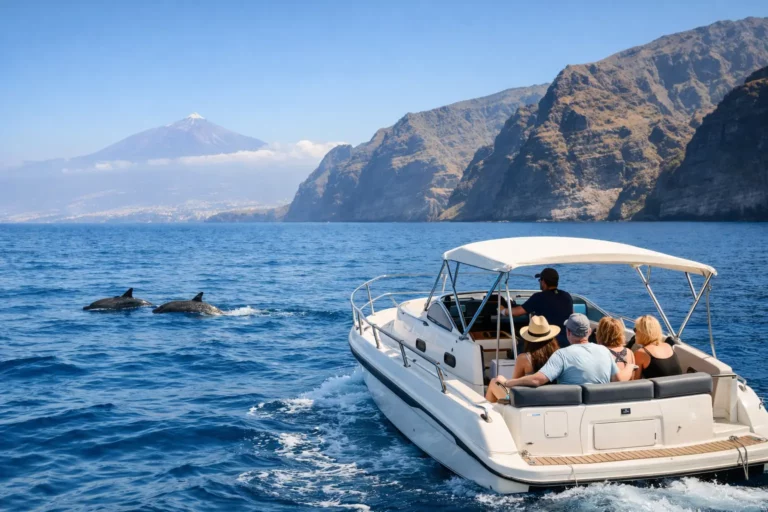
What sea turtles can you see around Tenerife? The species you are most likely to encounter is the loggerhead turtle, a beautiful ocean traveller that occasionally appears in Tenerife’s clear Atlantic waters. A turtle sighting is never something to promise or pursue too closely, but spotting one calmly surfacing beside a yacht is one of those quietly extraordinary moments that stays with you long after your holiday.
Tenerife sits on the migration routes of several turtle species, and its warm southern waters can provide feeding and resting grounds for visiting animals. For guests cruising from Costa Adeje or nearby ports, the possibility adds another layer of wonder to an already memorable day at sea - alongside the island’s resident pilot whales, playful dolphins, volcanic coastline and open Atlantic views.
The loggerhead turtle (Caretta caretta) is by far the most frequently recorded sea turtle around Tenerife and the wider Canary Islands. It is recognisable by its large, broad head, powerful jaws and reddish-brown shell. Adults can grow impressively large, while younger loggerheads may appear smaller and darker in the water.
Loggerheads are highly mobile. Some arrive after long journeys through the Atlantic and Mediterranean, while juvenile turtles may spend years travelling the open ocean before reaching feeding areas near the Canaries. Around Tenerife, they may be seen resting at the surface, gliding through calm water, or briefly lifting their heads to breathe before disappearing again.
A loggerhead encounter tends to be fleeting. From the deck of a comfortable yacht, you may notice the smooth outline of a shell, a head breaking the surface, or the distinctive slow movement of flippers beneath the water. The best sighting is always one that happens naturally, with the boat maintaining a respectful distance and allowing the turtle to continue its journey undisturbed.
Green turtles (Chelonia mydas) are less common around Tenerife than loggerheads, but they do visit Canary Island waters. Despite the name, their shells are often olive, brown or mottled rather than bright green. They have a smaller, more rounded head than loggerheads and are known for their gentler, graceful swimming style.
In other parts of the world, green turtles are closely associated with seagrass meadows. Tenerife’s marine environment is different, so their appearances here are more occasional and less predictable. When they are seen, it is often in sheltered or productive coastal areas where food is available.
For wildlife enthusiasts, the possibility of a green turtle is exciting precisely because it is unusual. Still, it is sensible to view it as a fortunate bonus rather than the purpose of a boat trip. Tenerife’s marine life does not perform to a timetable, and that is part of its appeal.
The leatherback turtle (Dermochelys coriacea) is the largest sea turtle in the world and a genuinely rare visitor to Tenerife waters. Unlike the hard-shelled species, leatherbacks have a dark, leathery body with pale markings and distinctive raised ridges running along their back.
These remarkable turtles are built for long-distance ocean travel and can range through deep Atlantic waters. They feed largely on jellyfish, which means sightings may be more plausible when jellyfish are present offshore. However, seeing a leatherback around Tenerife would be exceptional, not an everyday occurrence.
If one is spotted, it is a moment for quiet admiration rather than excitement around the animal. A leatherback’s size can be startling, but it remains a protected wild creature travelling through its natural habitat.
Hawksbill turtles and Kemp’s ridley turtles have been recorded in the Canary Islands, but encounters around Tenerife are extremely uncommon. Hawksbills are admired for their patterned shells and narrow, beak-like mouths; Kemp’s ridleys are the rarest of the world’s sea turtles. Neither should be expected on a Tenerife cruise.
Reports of an unusual turtle can sometimes be difficult to verify from a distance, especially when the animal surfaces only briefly. This is why responsible crews avoid making sweeping claims. A respectful sighting, accurately described, is worth far more than a dramatic story.
Sea turtles can potentially be seen around Tenerife throughout the year. The island benefits from a mild climate and warm Atlantic conditions, particularly in the south, so there is no short and fixed turtle season in the way there is for some land-based wildlife.
Conditions matter more than a particular month. Calm seas, good visibility and a period spent cruising away from the busiest harbour waters can make it easier to notice a turtle at the surface. Morning light may offer especially clear viewing, while afternoon trips can also be excellent when the sea remains settled.
That said, calm water does not create sightings. Turtles are free-ranging animals, and their movements depend on food, currents, water temperature and migration patterns that change from one week to the next. A day with no turtle encounter is not a poor wildlife cruise. South Tenerife is particularly valued for its resident pilot whales and regular dolphin activity, both of which are more dependable highlights offshore.
Most sightings occur offshore rather than close to a crowded beach. The waters south and south-west of Tenerife, beyond Costa Adeje and Los Cristianos, are often where boats encounter the island’s richest marine life. This is also the route taken by many whale- and dolphin-watching excursions.
Turtles may surface in open water with little warning, especially in quieter patches between other wildlife encounters. They are sometimes noticed near floating natural debris or areas where food gathers, although no responsible skipper should approach a turtle simply to obtain a closer photograph.
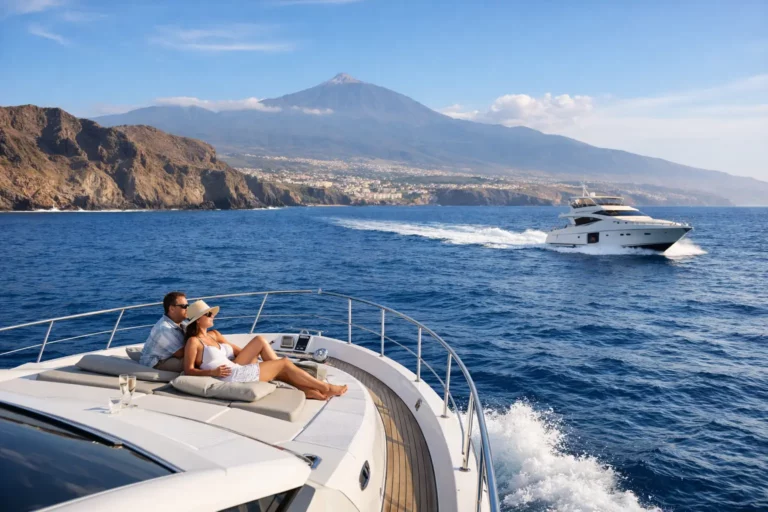
A private yacht charter offers a particularly relaxed way to enjoy this environment. There is room to sit comfortably, move around safely, enjoy refreshments and take in the coastline without the rush or crowding often found on larger excursion vessels. On a refined trip with Royal Ocean, the emphasis is on attentive hospitality and respectful observation, allowing the sea to set the pace.
A turtle can seem approachable when it is resting or breathing at the surface, but this does not mean it wants company. The most considerate encounters happen from the boat, with the engine and manoeuvres managed by an experienced skipper.
Do not touch, feed or attempt to swim after a turtle. Touching can remove protective coatings from its shell, cause stress and alter its natural behaviour. Feeding wildlife creates further problems by encouraging animals to associate boats with food.
If a turtle appears during a swim stop, return to the yacht or follow the crew’s guidance rather than trying to close the distance. Keep voices low, allow the animal a clear route away, and enjoy the privilege of seeing it on its own terms. Photographs are wonderful, but a calm, unhurried observation is usually the more memorable experience.
If seeing a turtle is at the top of your holiday wish list, choose a high-quality cruise for the experience as a whole rather than booking a trip that implies a guaranteed encounter. No ethical operator can guarantee wild turtles, and a promise to do so should raise questions about how animals are being approached.
Instead, look for a well-maintained yacht, a professional crew, manageable guest numbers and time on the water that feels unhurried. These details make a real difference whether the day brings a loggerhead at the surface, a pod of dolphins travelling alongside the bow, or simply a peaceful swim beneath Tenerife’s dramatic coast.
Keep your eyes on the horizon, listen to your crew and let wildlife appear as it chooses. In Tenerife, the most special marine moments are rarely scheduled - they are simply noticed.