A yacht’s wake can occasionally scatter electric-blue sparks across the Atlantic, as though the sea itself has caught the last light of the day. Marine bioluminescence and night navigation mechanics belong to the same after-dark seascape, yet they represent two distinct disciplines: one is a biological response from microscopic ocean organisms, while the other is the maritime methodology that keeps a vessel moving safely through the dark.
For passengers and mariners navigating coastal waters—such as those off south Tenerife—understanding this distinction adds practical context to an evening passage. While the ocean appears serene beneath the stars, a professional bridge crew relies on calibrated instruments, optical physics, and International Regulations for Preventing Collisions at Sea (COLREGs) to maintain a safe route long after the coastline fades into darkness.
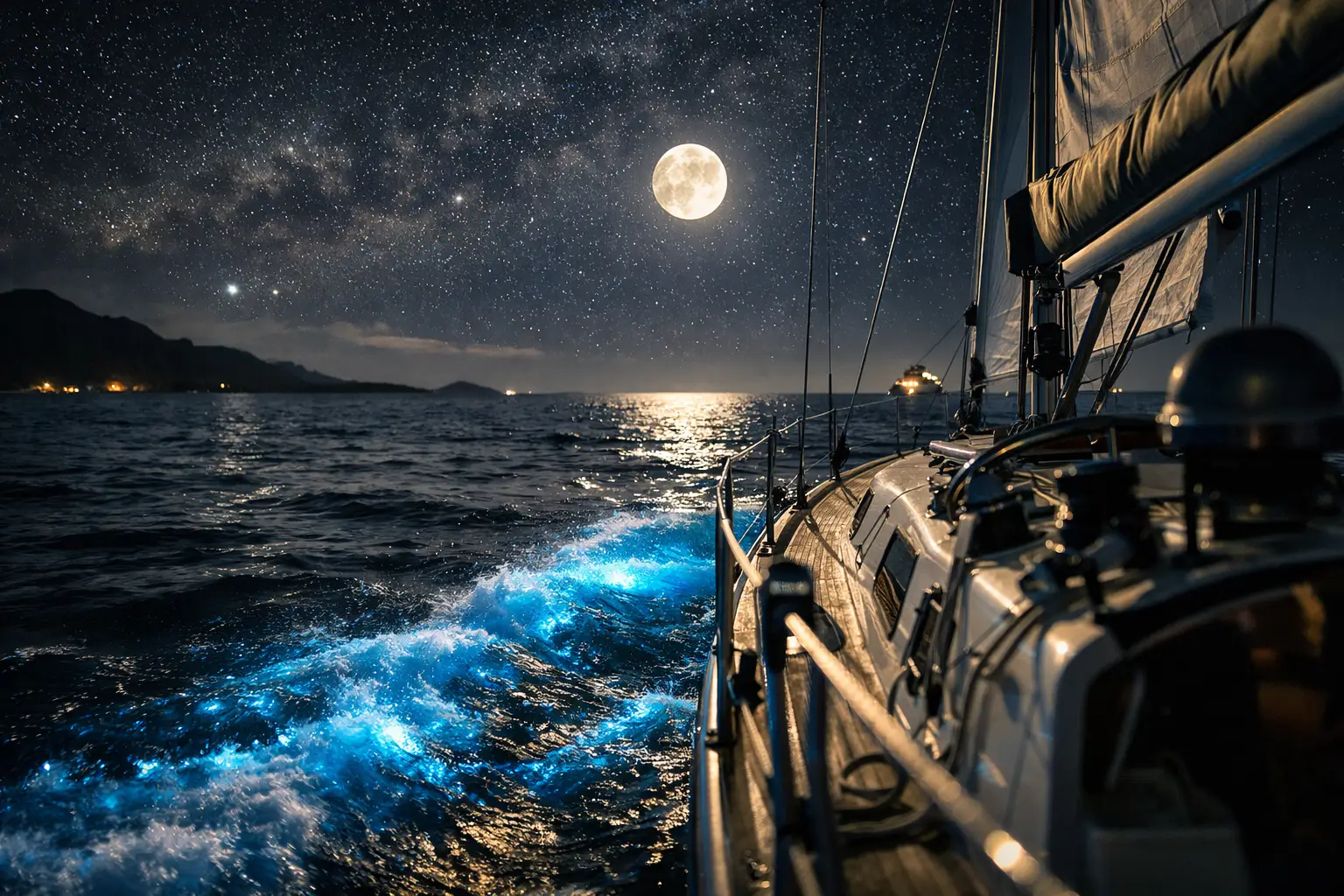
Most visible coastal marine bioluminescence is produced by microscopic single-celled plankton known as dinoflagellates (including species such as Pyrocystis fusiformis and Noctiluca scintillans). These organisms drift primarily within the epipelagic (surface) zone of the ocean.
Bioluminescence is a cold-light reaction, meaning less than 20% of the energy generates thermal radiation. The reaction takes place inside specialized cellular structures called scintillons:
The resulting release of energy produces a blue-green light that typically peaks around 470–490 nanometers (nm), depending on the species. This specific wavelength travels farthest through seawater, making it optimal for marine optical transmission.
In dinoflagellates, bioluminescence functions primarily as a defense mechanism against predators. A sudden flash can startle small grazers, such as copepods. It can also act as a "burglar alarm," illuminating the predator so that larger species higher up the food chain notice and consume it.
The term nocturnal plankton describes a daily behavioral cycle rather than a single light-emitting organism. Diel Vertical Migration (DVM) is recognized by marine biologists as the largest synchronized animal migration on Earth.
Every night, billions of zooplankton, micro-crustaceans (such as krill), and larval fish rise from the dark mesopelagic zone (200–1,000 meters deep) into surface waters to feed under cover of darkness, returning to the depths before dawn. While DVM dramatically increases the density of marine life near the surface at night, only specific organisms (such as certain dinoflagellates, jellyfish, comb jellies, and ostracods) possess the biological ability to glow. Dense concentrations of nocturnal plankton frequently occur without any bioluminescence.
The clear Atlantic waters around Tenerife provide excellent conditions for night cruising, but seeing glowing water requires specific environmental factors aligning at once.
The intensity and clarity of marine bioluminescence depend on environmental conditions and surrounding light:
| Factor | Optimal Conditions | Impact on Visibility |
|---|---|---|
| Moon Phase | New Moon / Low Illumination | Bright moonlight reduces the visual contrast of delicate light flashes. |
| Water Motion | Moderate Mechanical Shear | Physical agitation (wakes or waves) is required to trigger cellular reactions. |
| Nutrient Density | Post-Upwelling Coastal Water | Encourages higher dinoflagellate concentrations per liter of seawater. |
| Artificial Light | Offshore / Dark Sky | Shoreline illumination washes out subtle optical emissions. |
Bioluminescence can happen year-round in the Canary Islands, but it is most noticeable during the warm summer and early autumn months when nutrient levels and water temperatures support plankton blooms. Sheltered anchorages along the southern coast—away from major resort lighting in Costa Adeje and Los Cristianos—offer the dark skies necessary to spot faint light in a yacht's wake.
If you are taking an evening or night charter off Tenerife, a few simple habits will help you spot bioluminescence and stay comfortable on board:
While a glowing wake marks water disturbance behind a yacht, it provides zero guidance for running a vessel. Luminous water does not mark submerged rocks, unlit fishing gear, shallow reefs, or incoming traffic. Professional crews navigate at night by combining electronic instruments, hydrographic data, and visual monitoring.
Safe navigation at night relies on cross-checking several independent systems:
Human eyes adapt to low light as the photopigment rhodopsin builds up in the retina's rod cells. Reaching full night adaptation takes 20 to 30 minutes in total darkness.
Because low-intensity red light preserves dark adaptation far better than white light, bridge teams use red lighting for reading physical charts and monitoring instruments during night passages.
At night, identifying other vessels relies on light patterns established by the International Regulations for Preventing Collisions at Sea (COLREGs Part C).
Standard running lights tell a watchkeeper a target vessel's direction of travel, size, and operational status:
If a watchkeeper sees a steady bearing with a decreasing distance to a red sidelight, the other vessel is crossing from starboard to port, creating a risk of collision where the give-way vessel must alter course early.
The light is produced by microscopic dinoflagellates through a chemical reaction between the enzyme luciferase and the substrate luciferin. Physical movement causes protons to flow inside the cell, triggering a quick flash of light at a wavelength near 470–490 nanometers.
Yes. Tenerife's clear Atlantic waters frequently host bioluminescent dinoflagellates. The light is most visible on moonless nights in dark bays along the southern coast, well away from major town light pollution.
No. Marine radar transmits X-band or S-band radio waves and measures the energy reflected back from solid objects. Microscopic plankton are far too small to reflect radar signals.
In open ocean waters, bioluminescent plankton is safe to touch. However, during dense coastal algae blooms (red tides), certain dinoflagellate species produce toxins that irritate skin or airways. Night swimming also carries risks like reduced visibility and strong currents, so always check local marine conditions first.
Retinal rod cells in the human eye are far less sensitive to red light wavelengths above 620 nanometers. Using low-intensity red light allows the bridge crew to inspect equipment and charts without losing their dark-adapted vision.