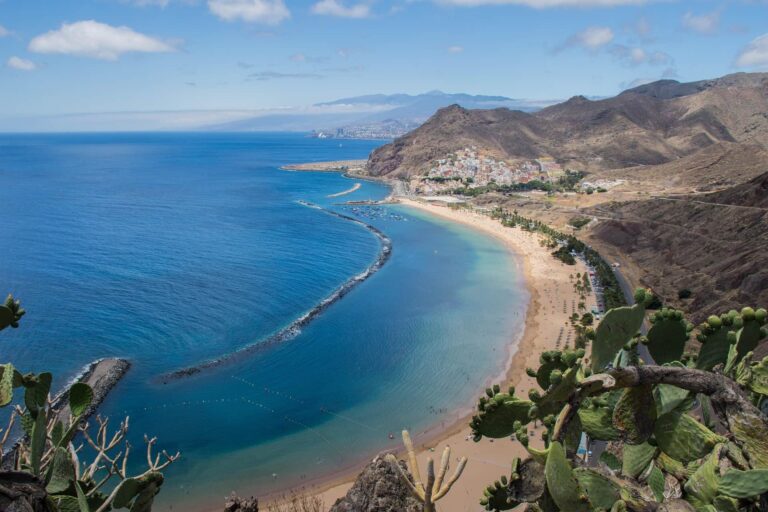
Stand on the waterfront of Santa Cruz de Tenerife today, and the modern capital feels entirely serene, dominated by avant-garde architecture, bustling cafes, and sunlit ocean promenades. Yet beneath this peaceful surface lies one of the most dramatic military episodes in Atlantic naval history. Long before Tenerife became a world-renowned destination for luxury private yacht charters and whale-watching cruises, its shores were the setting for a ferocious, high-stakes battle that handed Great Britain’s greatest naval hero, Horatio Nelson, his most legendary and physically devastating defeat.
For many international visitors, pairing the legendary Admiral Nelson with Tenerife feels unexpected. He is universally celebrated for his sweeping victories at the Nile and Trafalgar—the commanding officer who fundamentally defined British maritime supremacy. Yet in July 1797, off the coast of Santa Cruz, a daring amphibious assault went catastrophically wrong. The shattering wound he received here—resulting in the immediate amputation of his right arm—became a pivotal, life-altering turning point that permanently shaped his personal mythos.
Tenerife has an extraordinary way of holding historical contrasts. While it now offers tranquil sailing waters and refined coastal leisure, its past was aggressively forged by the fires of empire, trade monopolies, and naval warfare. In the summer of 1797, Spain was allied with Revolutionary France against Great Britain. Control of the Atlantic shipping lanes was paramount, as the Canary Islands served as the ultimate commercial pitstop for Spanish treasure galleons returning from the Americas.
Rear-Admiral Nelson, young, fiercely ambitious, and fresh from his brilliant success at the Battle of Cape St. Vincent, spotted an opportunity. Santa Cruz was not merely a convenient deep-water harbor; it was a heavily fortified commercial fortress protecting immense Spanish wealth. Nelson’s objective was clear: launch a swift, aggressive amphibious landing, overpower the local garrison, and seize a multi-million-peso treasure cargo reported to be aboard the Spanish ship El Príncipe de Asturias. On paper, British naval supremacy made victory seem inevitable. In reality, Nelson severely underestimated both the local terrain and the fierce resolve of Tenerife’s defenders.
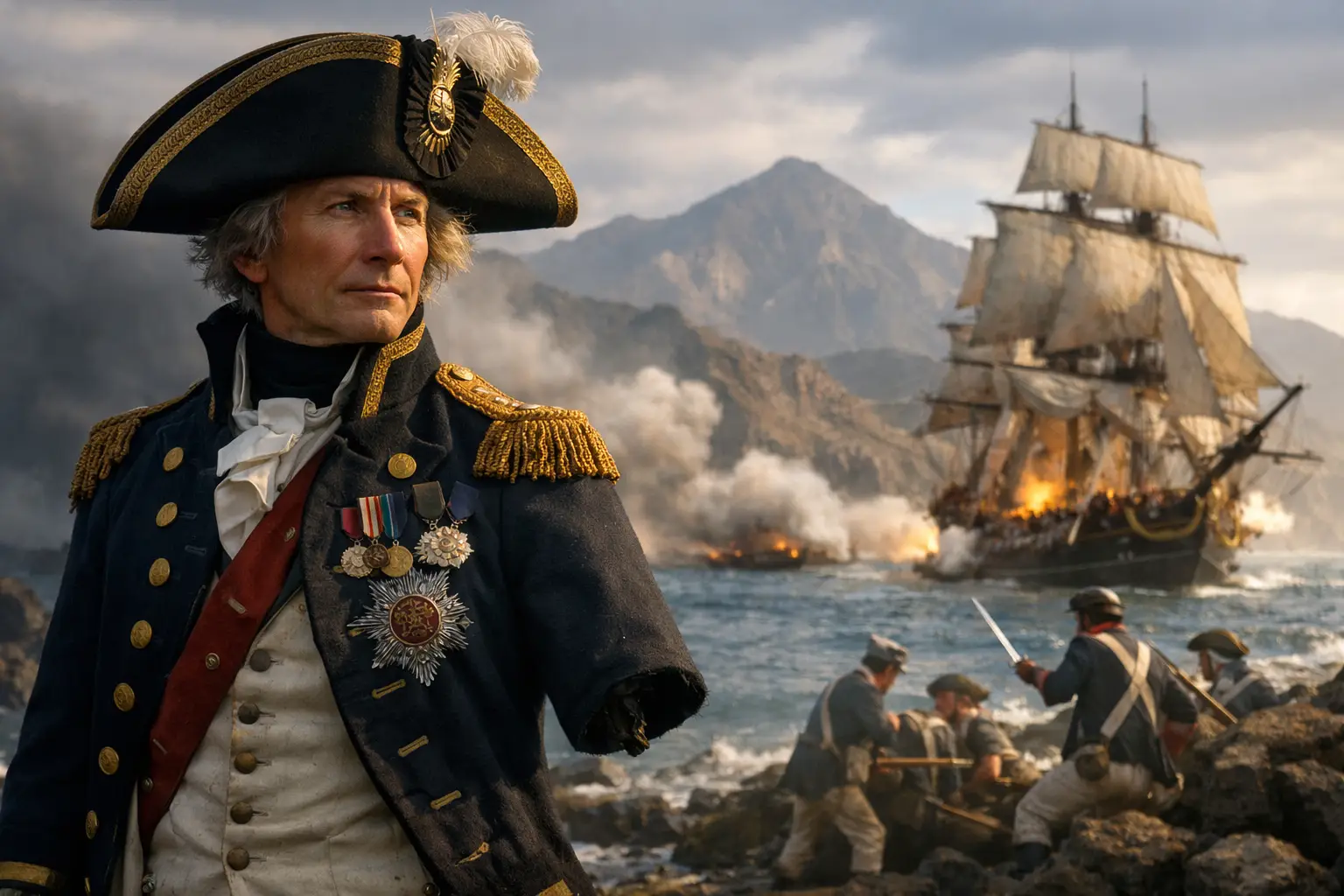
The decisive confrontation culminated during the pitch-black, stormy night of July 24–25, 1797. Having failed in earlier daytime landing attempts due to treacherous wind shifts and heavy surf, Nelson personally commanded a desperate midnight assault, leading around 1,000 British sailors packed into open wooden rowboats directly toward the heavily defended stone mole of Santa Cruz.
The element of surprise was instantly lost. As the British boats neared the shoreline, the Spanish coastal batteries, brilliantly organized by the local commander **General Antonio Gutiérrez**, unleashed a devastating crossfire. Trapped in a howling gale with crashing surf, many British boats were smashed against the rocks or sunk by heavy artillery fire.
The exact moment that altered naval history occurred just as Nelson was stepping ashore, drawing his sword. A heavy blast of Spanish grapeshot—or a musket ball, according to varied journal accounts—shattered his right elbow, tearing through bone and artery. Nelson collapsed into the arms of his stepson, Josiah Nisbet, who desperately tied a silk kerchief around the spurting wound to act as a tourniquet. Nelson was rowed back through the chaotic crossfire to his flagship, HMS Theseus, where his right arm was promptly amputated by the ship’s surgeon in the dark, blood-slicked cockpit.
No discussion of this famous historical encounter is complete without mentioning the true icon of the defense of Tenerife: **El Tigre (The Tiger)**. This legendary 18th-century bronze canon was positioned at the strategic San Cristóbal bastion, covering the exact beachhead where Nelson attempted his landing.
Local Canarian tradition strongly asserts that it was a perfectly aimed grapeshot from El Tigre that directly wounded Nelson and decimated his elite landing party. Today, this historic piece of artillery is meticulously preserved and can be visited by travellers beneath the Plaza de España in Santa Cruz. Studying this formidable weapon provides a deeply grounded, immediate perspective on the battle—a proud local victory that is celebrated annually by the residents of Tenerife with vibrant historical reenactments along the old harbor stone walls.
There is a profound historical irony surrounding the Battle of Santa Cruz. Nelson’s absolute military failure in Tenerife did not diminish his long-term career; instead, it elevated his legendary aura. He survived a disastrous tactical miscalculation, endured a brutal battlefield amputation, and returned to active service with a signature empty right sleeve pinned to his uniform—a visible, undeniable badge of ultimate physical sacrifice and courage that endeared him to the British public.
For Tenerife, however, the battle remains a masterclass in military defense. General Antonio Gutiérrez, utilizing a mixed force of regular Spanish soldiers, French sailors, and passionate local Canarian peasant militias, completely outmaneuvered the elite Royal Navy. Nelson was forced to sign a formal, honorable capitulation agreement, promising never to attack the Canary Islands again. In an elegant display of 18th-century chivalry, General Gutiérrez even provided the defeated, wounded British forces with fresh bread, wine, and medical supplies before they sailed away.
There is something uniquely powerful about experiencing an island’s military and maritime heritage directly from the sea. Approaching the rugged coastline of Tenerife by boat provides an immediate, visceral understanding of naval strategy, exposure, and coastal defense. The dramatic cliffs, shifting wind currents, and treacherous landing points that seem abstract in history books suddenly reveal their tactical logic when viewed from the water.
The Atlantic ocean surrounding Tenerife has always been defined by this deep, restless relationship with maritime history—operating as a crucial gateway, a strategic prize, and a frontier for world empires. When you step on board a modern, premium yacht with Royal Ocean, you are seamlessly gliding through the exact historical waters that once echoed with heavy canon fire and imperial ambition. Embracing these rich, authentic layers of local history does not make your day at sea feel heavier; it transforms a beautiful scenic cruise into a profoundly sophisticated, elite, and unforgettable travel experience.