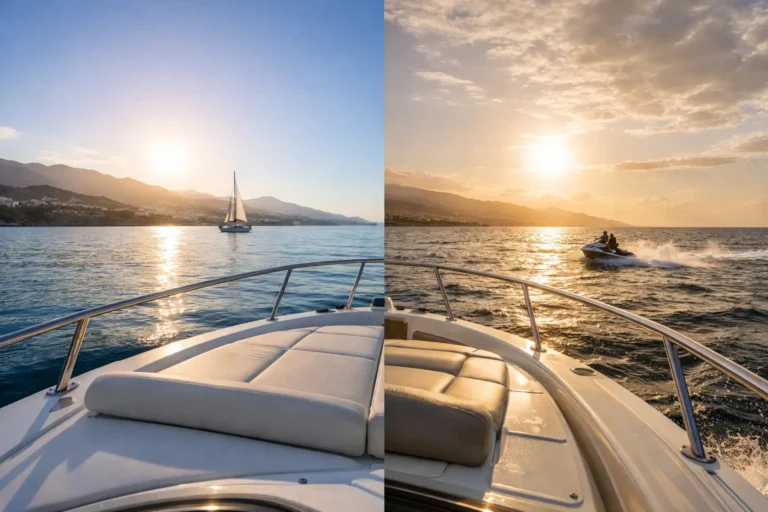
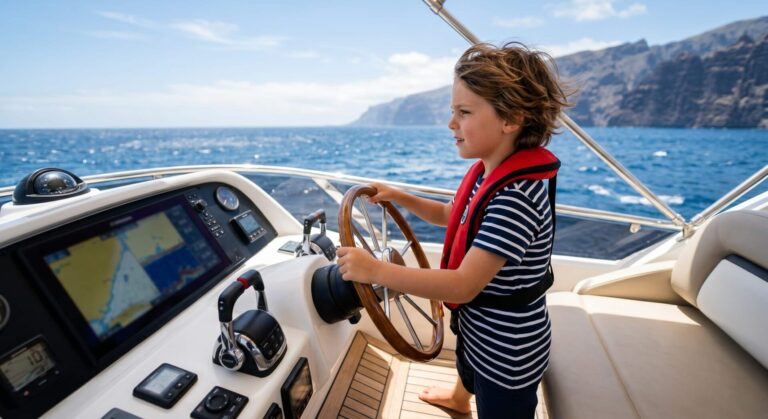
A yacht trip can be one of the highlights of a family holiday in Tenerife, but travelling with small children requires a little more thought than simply stepping aboard and setting off. Shade, safety equipment, sea conditions, trip length and the timing of the cruise can all make a noticeable difference to how comfortable the day feels.
For parents, the goal is simple: everyone should have enough space to relax, children should have somewhere comfortable to retreat from the sun, and the itinerary should leave room for snacks, naps, swimming and the occasional change of plan. On Tenerife's south coast, where sunshine is plentiful and the Atlantic can change throughout the day, good preparation makes the experience much easier.

The best family charter begins before you arrive at the marina. When booking, tell the operator that you are travelling with young children and mention anything that could affect their comfort, such as motion sensitivity, nap times or limited swimming confidence.
A responsible operator should be able to explain how boarding works, what safety equipment is available for children, what happens if the weather changes and which areas of the yacht are most suitable for younger passengers.
Correctly sized lifejackets are particularly important. A large adult lifejacket is not a substitute for equipment designed to fit a child properly. Parents should also know where the safety equipment is kept and listen carefully to the crew's briefing before departure.
The layout of the yacht matters too. Clear walkways, secure handrails and comfortable access between seating areas make it easier for parents to keep children close. A covered seating area gives younger passengers somewhere to rest while adults continue to enjoy the views.
One of the first questions parents should ask is surprisingly simple: Where can my child sit in the shade?
Tenerife's sunshine can be strong even when the sea breeze makes the air feel pleasantly cool. Reflected light from the water adds to the overall exposure, and young children can become uncomfortable or overheated before parents realise how much sun they have received.
A proper shaded seating area is therefore much more useful than a small section of canopy that disappears as the yacht changes direction. On a private charter, the extra space also makes it easier to settle children somewhere comfortable and adjust the pace of the day around their needs.
Bring high-factor sunscreen suitable for children, a secure hat, UV-protective swimwear and a light cover-up. Sunscreen should be reapplied after swimming and towel drying, even if your child spends much of the cruise under cover.
There is another reason to bring an extra layer: the sea breeze can feel surprisingly cool when a child is wet, tired or returning to the marina later in the day. A dry change of clothes and a light jacket take up little space and can make the final part of the trip much more comfortable.
Safety on a family yacht should feel organised rather than intimidating. Before departure, the crew should explain the basic rules and point out the areas where children should be particularly careful.
Parents remain responsible for supervising their children, but an experienced crew can provide an important additional layer of support. They can help during boarding, advise on the most comfortable seating and recognise when changing sea conditions call for a quieter part of the yacht.
When comparing charter providers, it is reasonable to ask whether safety equipment is regularly inspected, whether first-aid equipment is carried on board and what the procedure is if weather or sea conditions change.
The real sign of a well-run charter is calm competence. The crew should be comfortable changing the route, postponing a swim stop or altering the plan when conditions no longer suit the passengers.
With babies and toddlers, longer is not necessarily better. A two- or three-hour private cruise can be enough time to enjoy the coastline, look for marine life and have a short swim stop without making the day exhausting for a young child.
Shorter trips also leave room for the unpredictable parts of travelling with children. A toddler may suddenly need a snack, a nap or some quiet time, and there is much less pressure when the itinerary has not been planned around a full day at sea.
For older children, longer charters may work very well, particularly if they enjoy swimming, snorkelling and wildlife watching.
If you want a private experience that can be adapted around your family, a private whale and relaxation cruise gives you more flexibility than a fixed group excursion.
There is no single best departure time for every family. Your child's routine may be more important than a theoretical difference in sea conditions.
Morning departures can be attractive for younger children because temperatures are generally more comfortable early in the day and local breezes may still be relatively light. They also leave the afternoon free for lunch, the beach or a quiet rest at the hotel.
Afternoon departures can work particularly well for families with older children. The day starts without an early alarm, temperatures are warmer and the atmosphere becomes more relaxed as the afternoon progresses. A later trip can also lead naturally into sunset.
If your child is happiest before lunch, there is little reason to force an afternoon charter simply because the evening light looks attractive in photographs. Conversely, if mornings are difficult because of sleep schedules, a later departure may make the whole experience considerably more enjoyable.
For many children, the chance to jump into the Atlantic is the most exciting part of a yacht trip. But swimming from a boat requires more attention than swimming in a pool or at a supervised beach.
Before anyone enters the water, the crew will assess the conditions and determine whether the planned swim stop is suitable. Wind, swell, currents and nearby boat traffic can all influence that decision.
Children who are not confident swimmers should remain within arm's reach of a supervising adult. Buoyancy aids can provide additional support, but they do not replace active supervision.
It is also useful to have towels and dry clothes ready before children leave the water. Young children can become cold surprisingly quickly once they are back on a moving deck, particularly when the wind picks up.
And if the skipper decides that swimming is not appropriate on a particular day, that does not have to spoil the trip. Watching the coastline, looking for dolphins or whales and enjoying time together on deck can still make a memorable family outing.
Seeing a whale or dolphin from a yacht can be an extraordinary experience for a child. Tenerife's waters are home to resident pilot whales, while dolphins and other marine life may also be encountered throughout the year.
Wildlife is unpredictable, however. No responsible operator can promise that a particular animal will appear at a particular time.
It helps to prepare children for this before leaving the marina. Explain that the animals are wild and that the boat may need to wait quietly or keep its distance. This turns the sighting into an observation exercise rather than a chase.
Simple binoculars can be useful for older children, while younger ones may be happy simply watching the horizon. A calm crew and a comfortable shaded seat can make a bigger difference than keeping children constantly entertained.
If wildlife watching is a major reason for your trip, consider a private whale and relaxation cruise where the pace and route can be adapted to the conditions of the day.
| Category | What to Bring |
|---|---|
| Sun protection | High-factor sunscreen, hats, sunglasses and UV-protective swimwear |
| Clothing | Swimwear, a dry change of clothes and a light layer or windbreaker |
| Comfort | Towels, drinking water, familiar snacks and any necessary medication |
| Entertainment | One small quiet activity, book or pair of binoculars |
Keep the bag compact. Bulky pushchairs, hard-sided coolers and toys that can roll around the deck are more trouble than they are worth on most yacht trips.
If your child has a favourite comfort item, bringing it can also make the unfamiliar surroundings of a boat feel much easier, especially if they become tired during the trip.
One of the biggest advantages of a private yacht charter with children is flexibility. You do not have to structure the entire day around someone else's timetable or worry that a toddler needing a snack or a quiet moment is disturbing the rest of the group.
Tell the crew what matters to your family before departure. Perhaps your child needs a regular nap, an older child is eager to swim, or you would prefer a quieter route with plenty of time to watch marine life.
For birthdays and other family celebrations, Royal Ocean's special-events yacht charter can also be adapted around the occasion, giving families private space to enjoy the day at their own pace.
The best family yacht trip is rarely the one that fits the most activities into a few hours. It is the one where children remain comfortable, parents are relaxed and everyone has enough time to enjoy being on the Atlantic together.
Yes, provided the yacht, crew and itinerary are suitable for young passengers. Ask about correctly sized child lifejackets, usable shade, boarding arrangements and the operator's approach to changing sea conditions before booking.
A two- to three-hour private cruise is often a good starting point for families with babies or toddlers. It allows enough time for cruising, wildlife watching and potentially a short swim without making the day too tiring.
Morning can be preferable for families with young children who are happiest earlier in the day and may benefit from cooler temperatures. Afternoon trips can suit older children and families who prefer a slower start, warmer conditions and the possibility of a sunset finish.
Children should have correctly sized safety equipment appropriate for their age and size. Ask the operator which lifejackets are provided, where they are kept and when children are required to wear them. Always follow the skipper's instructions.
Swimming may be possible when sea conditions and the chosen location are suitable. The skipper decides whether a swim stop is appropriate. Children who are not confident swimmers need close adult supervision even when using flotation equipment.
Bring sunscreen, hats, sunglasses, swimwear, towels, water, familiar snacks, a dry change of clothes, a light layer and any necessary medication. One small quiet activity can also be useful for younger children.