Pilot whales, also known as grindas or globicephalous whales, belong to the dolphin family (Delphinidae) and are the second-largest representatives of this family after killer whales. The scientific name of the genus Globicephala comes from the Latin word "globus" (sphere, globe) and Greek "kephale" (head), reflecting their most characteristic morphological feature — a massive spherical head, scientifically called the "melon."

There are two species of pilot whales: the short-finned (Globicephala macrorhynchus) and the long-finned (Globicephala melas). Off Tenerife and other Canary Islands, a population of short-finned pilot whales inhabits the region, representing a stable community of approximately 2,000 individuals and constituting one of the most well-studied populations of this species.
Kingdom: Animalia
Phylum: Chordata
Class: Mammalia
Order: Cetacea
Family: Delphinidae
Genus: Globicephala
Species: Globicephala macrorhynchus
Common names: Short-finned pilot whale, grinda, globicephalous whale
Recent genetic studies have revealed the existence of at least three genetically distinct populations of short-finned pilot whales, separated by geographic barriers. These include the Atlantic type, Western Pacific and Indian types (Naisa), and Eastern Pacific and Northern Japanese types (Shiho). The Canary Islands population belongs to the Atlantic type, which is considered a distinct population unit.
Short-finned pilot whales exhibit pronounced sexual dimorphism, with adult males being significantly larger than females:
This size difference between sexes is among the most pronounced in delphinids and reflects the species' reproductive strategy and social structure.
Short-finned pilot whales possess several distinctive morphological characteristics:
Head and Melon: Arguably the most recognizable feature is the massive, club-shaped head, or melon. In adult males, this structure is much more developed than in females and may be rounded or slightly protruding above the mouth in older individuals. Unlike many dolphins, pilot whales lack a prominent rostrum (beak); instead, the head transitions to a short snout.
Dorsal Fin: The dorsal fin is located in the anterior half of the body and has a characteristic sickle shape with a rounded tip. The fin's base is broad and elongated. In males, the dorsal fin is considerably larger than in females, potentially reaching heights exceeding 30 centimeters. In juveniles, the fin appears more acute and upright, resembling a dolphin's dorsal fin.
Pectoral Flippers: Unlike long-finned pilot whales, the pectoral flippers of the short-finned species are relatively shorter, comprising approximately 1/6 of body length. They have a curved, sickle-like shape with pointed tips.
Coloration: The primary body color is black or dark grayish-brown. However, this species is characterized by various light markings:
Fluke (Tail): The tail stock is thick and muscular. The fluke itself has acute, pointed flukes with a span of approximately 130 centimeters.
Dentition: Short-finned pilot whales have 7–9 conical teeth on each side of both upper and lower jaws, designed for prey capture rather than mastication. Total tooth count ranges from 28–36 tooth pairs.
Short-finned pilot whales inhabit tropical, subtropical, and warm temperate waters worldwide. Their range encompasses:
Populations have been documented off Japan, Spain, Africa, California, India, Hawaii, Madeira, the Canary Islands, Caribbean waters, and other regions.
The Canary Islands, particularly off Tenerife, constitute a key distribution center for short-finned pilot whales. The regional population comprises approximately 2,000 individuals permanently residing in the area.
On Tenerife, the stable population is concentrated primarily in the southwestern portion of the island, where approximately 636 individuals have been identified through distinctive dorsal fin markings. Research has revealed 11 stable groups or "pods" inhabiting this region.
Pilot whales prefer:
The population is distributed in the leeward portions of all islands except El Hierro. Individual animals or small groups have been observed at Gran Canaria (117 individuals) and La Gomera (11 individuals), with additional comparative observations with Madeira populations.
This population has played an exceptionally important role in developing whale-watching tourism in the Canary Islands, allowing researchers and tourists relatively easy opportunities for studying and observing these animals.
One of the most remarkable aspects of short-finned pilot whale biology is their extraordinarily complex social organization, most closely resembling the social structure of resident killer whales.
Pod Structure: Pilot whales live in stable social groups called pods, typically consisting of 10–30 individuals. Each pod is generally female-biased, with female-to-male ratios potentially reaching 8:1. However, larger aggregations occur when several pods unite, potentially numbering 100 or more individuals.
Matrilineal Organization: Pod social structure is based on maternal lineages (matrilineality). This means young pilot whales remain with their mother throughout their lifetime, including adulthood. Unlike many mammalian species, males do not leave their natal pod to seek mates. Instead, mating occurs when multiple pods gather, with males from one pod temporarily mating with females from other pods, preventing inbreeding.
Matriarch Role: Each pod is typically led by the oldest female, who serves as the pod's leader and plays an important role in transmitting information about feeding locations, migration routes, and other vital knowledge to younger generations.
Pilot whales exhibit various behavioral modes depending on time of day and current activities:
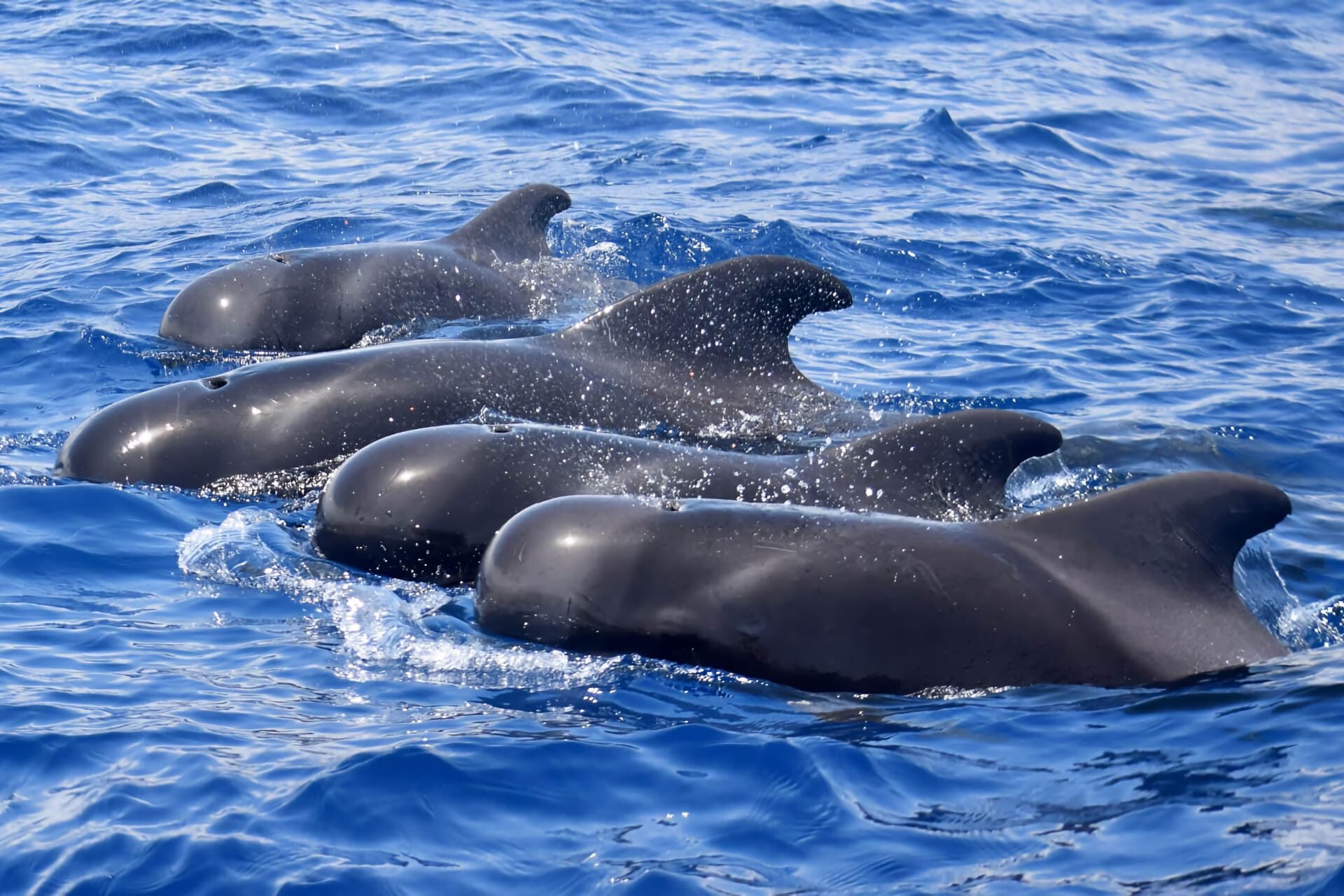
Pilot whales are renowned for their social behavior and playfulness:
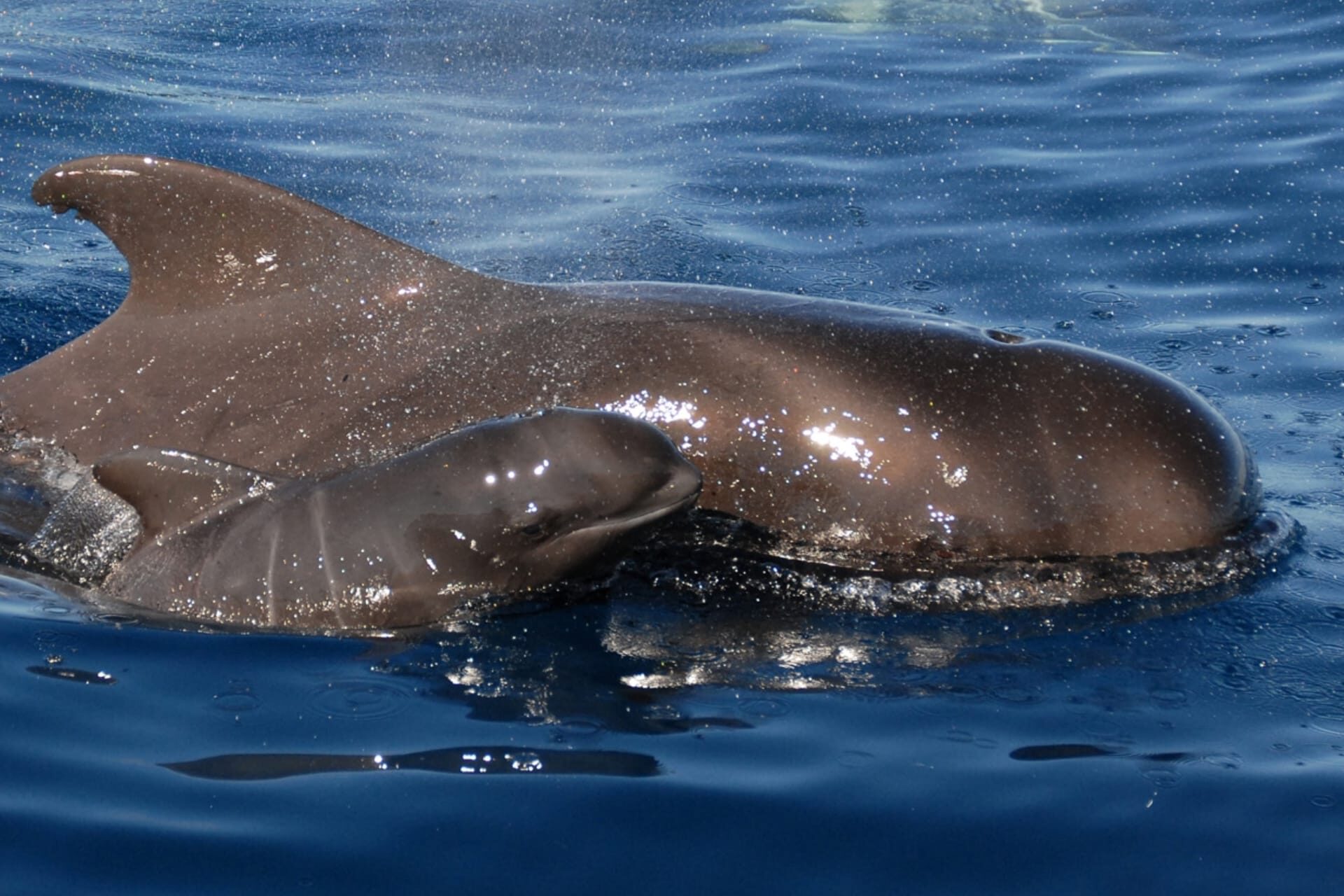
Pilot whales exhibit complex parental care behaviors, including alloparental care — when pod members who are not biological parents assist in caring for other females' calves. This behavior is particularly pronounced in long-finned species and appears less developed in short-finned pilot whales.
Elderly, post-reproductive females play active roles in calf rearing, teaching hunting methods and food sources to younger animals.
Short-finned pilot whales primarily feed on deep-sea squid, a dietary specialization reflected in their specialized hunting adaptations. Their diet includes:
Recent research has shown that pilot whales employ a striking and unusual hunting style, termed "the cheetahs of the deep sea" hunting strategy (Woods Hole Oceanographic Institution). Key features of their hunting strategy include:
This hunting style contrasts sharply with beaked whale hunting, which is slower, more prolonged, and involves pursuit of smaller prey — a strategy some researchers compare to "foraging."
Mating Season: Occurs year-round, but reproductive peaks occur July–August in the Northern Hemisphere. In the Southern Hemisphere, birth peaks occur in spring and autumn.
Gestation: Lasts 15–16 months (slightly longer than in long-finned pilot whales, which have 12–16 month gestation periods).
Calves at Birth: Neonates measure 1.4–1.9 meters in length and weigh approximately 60 kilograms.
Lactation: Calves nurse for a minimum of 2 years, though lactation frequently continues 5 or more years. In some cases, females may continue lactating up to 15 years after the last calf's birth, providing nutrition to other young pod members.
Birth Interval: Females produce offspring approximately once every 5–8 years (average ~7 years). Over a reproductive lifetime, a female may produce 4–5 calves.
Unlike most mammals, short-finned pilot whales (like their long-finned relatives and killer whales) represent a rare example of mammals where females undergo true menopause (Nature journal). Females typically cease reproduction around age 40 but continue living much longer, often for decades.
These post-reproductive females continue playing important roles in pod social structure, transmitting knowledge, assisting with calf care, and potentially serving as "keepers" of pod traditions.
The longevity difference between sexes represents one of the most dramatic disparities among cetaceans, reflecting different reproductive investments and aging processes between the sexes.
Pilot whales have evolved a comprehensive suite of morphological adaptations for life in high-pressure, deep-water environments:
Oxygen Reserves: Compared to terrestrial mammals, pilot whales possess:
Lung Collapse: Whale lungs can compress during dives, allowing:
Body Structure: The thick tail stock contains fat reserves serving both as energetic resources and hydrostatic assistance during descent and ascent.

Bradycardia (Heart Rate Slowing): During dives, heart rate decreases, reducing oxygen consumption and slowing oxygen depletion.
Selective Perfusion: Blood is redirected from non-critical organs (such as limbs) to vital organs (brain, heart) for oxygen conservation.
Anaerobic Metabolism: Muscles can transition to anaerobic metabolism, utilizing stored energy substrates when oxygen levels decline.
Carbon Dioxide Tolerance: The organism can withstand elevated CO₂ levels without triggering panic responses associated with hypoxia.
Pre-Dive Breathing: Prior to dives, whales increase respiratory frequency 5–10 minutes before and immediately after deep dives (deeper than 31 meters), optimizing oxygen reserves.
Pressure Management: Whales have evolved sophisticated mechanisms for managing gas exchange at all depths, enabling oxygen extraction during dives while minimizing inert gas absorption.
Pilot whales, like all toothed whales, employ a sophisticated echolocation system for navigation and hunting in dark, deep waters:
Sound Production: Sounds are produced by passing air through specialized tissues called phonic lips, located in nasal passages beneath the blowhole. Air passing the phonic lips enters specialized air sacs.
Sound Focusing: Sound waves are focused through skull structures, particularly via the fatty melon organ on the head, where sounds concentrate and project into the water.
Echo Reception: Returning sound waves are perceived through an acoustic reception window in the lower jaw, transmitting vibrations to the inner ear.
Echolocation Click Frequency: Pilot whales produce clicks within 5–150 kilohertz (kHz) ranges, with species-specific vocalization characteristics.
Beyond echolocation clicks, pilot whales produce:
Whistles: Used for maintaining contact among pod members and social interaction.
Burst Pulses: Complex sound sequences conveying directional and intensity information, varying with behavioral state (active or passive).
Inter-species Differences: Long-finned pilot whales produce relatively low-frequency sounds with narrow frequency ranges compared to short-finned whales, potentially representing adaptation to different acoustic environments.
Intriguingly, pilot whales can regulate their vocalizations and produce echolocation clicks even at extreme pressures during deep dives. This is achieved through sophisticated air management mechanisms in the nasal passages, allowing the animal to maintain echolocation capabilities despite air depletion.
Short-finned pilot whales in the Canary Islands constitute a resident population, meaning they remain in their territory year-round without undertaking lengthy migrations. However, they execute localized movements in response to seasonal fluctuations in prey availability:
Summer Movements: During summer months, whales tend to move further offshore, following deep-sea squid migrations.
Winter Movements: During winter months, whales may remain closer to shore, though remaining in areas of considerable depth.
Compensatory Swimming: In the Strait of Gibraltar, where strong Atlantic currents flow into the Mediterranean Sea, pilot whales frequently swim westward to compensate for currents and maintain preferred territories. During tidal slack periods, when currents weaken, animals may relax and engage in socialization.
Available data indicate that pilot whales exhibit certain degrees of territoriality. Multiple families (pods) regularly inhabit specific areas, and photo-identification research has allowed tracking of individual animals' repeated appearances in the same areas across many years.
One of the most enigmatic and tragic aspects of pilot whale behavior involves mass strandings, also known as "beach strandings" or "mass aggregations." When groups of healthy or near-healthy animals suddenly strand on beaches, this typically results in mortality.
Problem Scope: Annually, thousands of whales and dolphins strand on beaches worldwide. While most strandings result in animal mortality, this does not threaten species viability. However, for individual animals, these are high-mortality events.
Most Affected Species: Among approximately 90 cetacean species, only roughly 10 frequently strand en masse. All frequently-involved species are toothed whales rather than baleen whales. Pilot whales rank among the most frequently stranding species, particularly in Australia and New Zealand.
Pilot whales are particularly susceptible to mass strandings due to their biology and behavior:
Deep-Water Existence: Living at substantial depths means these animals rarely interact with shallow coastal waters and may lack well-developed shallow-water avoidance mechanisms.
Strong Social Structure: Tight social bonds within pods mean that if one or several animals encounter distress, others typically follow, potentially resulting in stranding.
Matriarchal Dependency: If the leading elder female (matriarch) becomes disoriented or ill, the entire pod may follow her into shallow water.
Scientists have proposed several hypotheses explaining mass strandings:
Echolocation Interference: Some researchers hypothesize that seafloor topography or particular acoustic conditions in coastal zones may create echolocation interference.
Disease or Parasites: Disease or parasitic infection potentially causes pod leader disorientation.
Navigation Errors: Pilot whales utilize Earth's magnetic field for orientation. Some stranding beaches exhibit unusual magnetic anomalies, potentially causing navigation errors.
Pollution and Bioaccumulation: Toxin accumulation in organisms may cause nervous system damage and disorientation.
Social Fidelity: Strong social cohesion means that even if direction is incorrect, animals remain with the group.
Military Sonar: Proven associations exist between military mid-frequency active sonar use and beaked whale mass strandings, though direct causative links to pilot whale strandings remain less conclusive.
Contemporary researchers employ drones and aerial photography to track pre-stranding whale behavior, hoping to develop early warning and intervention methods.
Adult pilot whales have few natural predators in the wild, due to their size and social structure. However:
Killer Whales (Orcas): Represent the primary natural predator, capable of attacking both young and adult individuals. Documented cases exist of pilot whales actively repelling orcas from their territories, presumably protecting calves.
Humans: Historically, humans were significant predators, hunting pilot whales for meat, oil, and fat. During the 19th and 20th centuries, the whaling industry deliberately targeted this species.
Pollution: Microplastics, heavy metals, and chemical pollutants accumulate in whale organisms, particularly in long-lived females.
Bioaccumulation: Pilot whales consuming squid accumulate pollutants derived from their prey. These animals' fat may contain high concentrations of polychlorinated biphenyls (PCBs) and dichlorodiphenyltrichloroethane (DDT).
Fishery Depletion: Overfishing of fish and squid may cause food shortages, potentially forcing whales to hunt closer to shore or seek alternative food sources.
Maritime Traffic: Ship strikes, though less frequent than in other species, remain a risk.
Noise Production: Vessel and military equipment noise may disrupt echolocation and communication among pod members.
Climate Change: Alterations in water temperature and currents may affect prey distribution, impacting whale food availability.
Oil Spills: Oil contamination may damage blowholes and exert toxic effects on animals.
IUCN (International Union for Conservation of Nature): Globally, the short-finned pilot whale holds a "Data Deficient" status, indicating insufficient information for comprehensive population assessment.
However, this may reflect research insufficiency rather than favorable population status. In many regions, populations are well-studied and appear relatively stable, though unknown threats may persist.
Pilot whales are protected through various international and national instruments:
The Canary Islands population, particularly in southern Tenerife, constitutes one of the most well-studied and relatively healthy populations. However, in 2007, the population faced significant crisis from a morbillivirus outbreak (marine mammal distemper), resulting in substantial population reduction.
The population recovers slowly, but this incident underscored population vulnerability to disease and environmental stressors.
Short-finned pilot whales (Globicephala macrorhynchus) exemplify marine ecosystem complexity and marine mammal adaptability. These animals demonstrate remarkable specializations for extreme-depth living, social structures rivaling primate complexity, and unusual life strategies including menopause and extended longevity.
The Canary Islands population provides a window into this species' behavior and ecology, enabling the scientific community to better understand their marine ecosystem role and assess threats they face. Further research and conservation measures are essential to ensure future generations can appreciate the magnificence of these remarkable deep-sea hunters.
The material presented in this article is based on scientific literature, including research published in Journal of Animal Ecology, Journal of Experimental Biology, Behavioral Ecology, and information from authoritative sources such as NOAA Fisheries, the International Whaling Commission, and various university research centers specializing in marine mammals.