The best stargazing spots across Tenerife's Teide National Park offer an exceptional night sky experience. However, a successful trip requires more than rushing uphill after dinner and hoping for the best. To truly appreciate this natural wonder, visitors must swap the ambient glow of the coast for high-altitude silence, allow their eyes time to adjust, and select a viewpoint where the volcanic landscape feels as dramatic as the stars above it. For travellers staying in Costa Adeje or Los Cristianos, this excursion represents one of the most memorable evenings of a Tenerife holiday, provided it is planned with care.
Teide National Park sits high above the island's coastal resort areas, frequently positioning itself above the local cloud layer and far from the island’s brightest artificial lights. On a clear, moonless night, the Milky Way appears with remarkable definition, while familiar constellations feel close enough to trace across the sky. Yet, this remains a wild mountain environment rather than an attraction with a polished promenade. The most refined experience comes from comprehensive preparation.
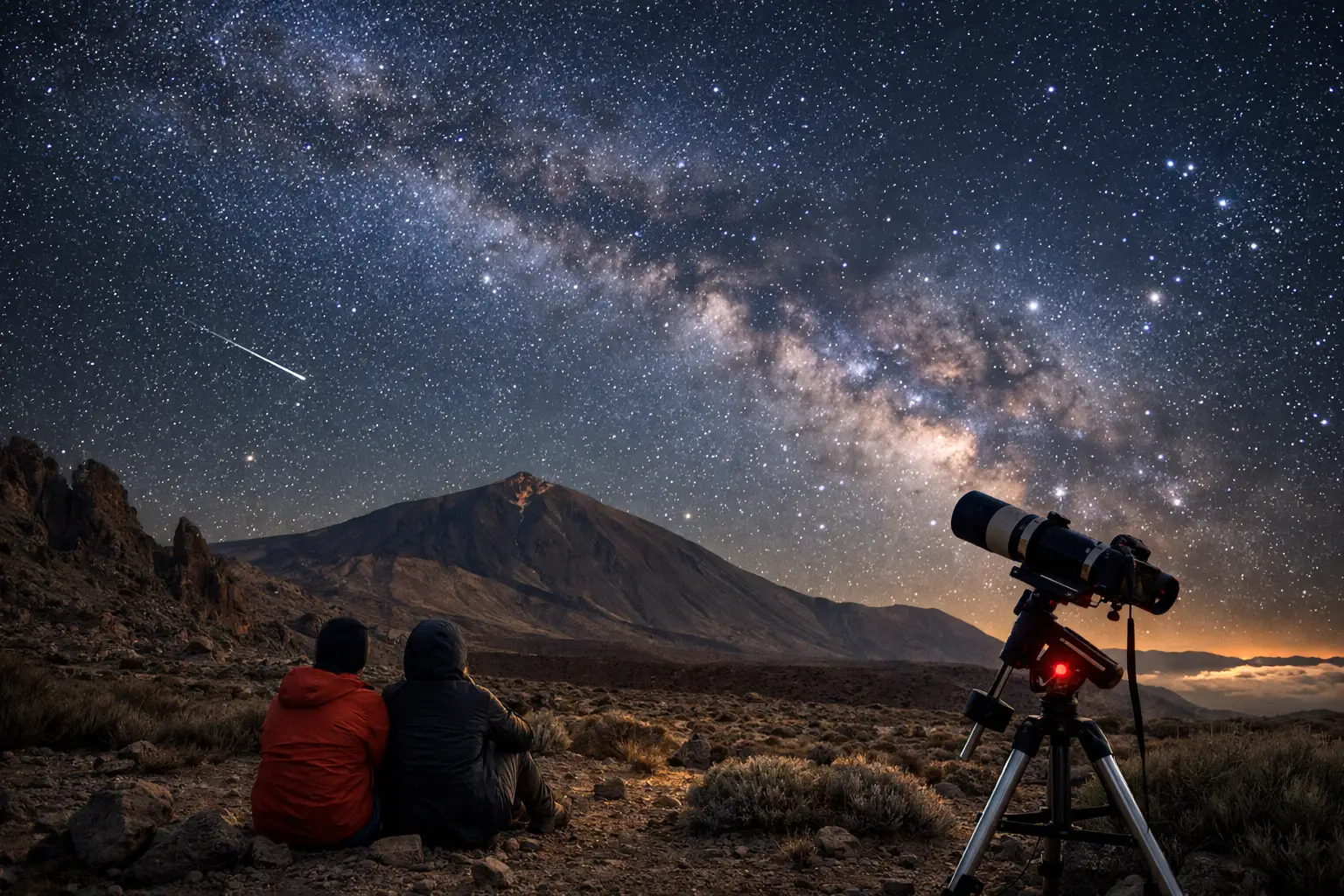
Tenerife is celebrated for warm coastal evenings, but the island’s most impressive night sky is found at altitude. The park’s dry air, volcanic terrain, and distance from urban lighting create optimal conditions for observing stars, planets, and seasonal meteor showers. Furthermore, professional astronomy maintains a strong presence on the island for this very reason: the high mountain atmosphere delivers exceptional clarity.
Conditions can change quickly. A clear evening on the southern coast does not guarantee an open sky within the caldera, and a bank of cloud can be either disappointing or spectacular depending on where it settles. When you stand above the clouds, they form a soft white sea beneath the stars. However, if the cloud layer reaches your chosen viewpoint, it can obscure visibility within minutes.
The true luxury of the park is not simply seeing a higher volume of stars. It is securing the time, warmth, and calm to observe them properly rather than treating the outing as another item on a crowded holiday itinerary.
| Viewpoint | Best For | Accessibility | Key Considerations |
|---|---|---|---|
| Minas de San José | Astrophotography & wide horizons | Easy parking, open terrain | Lunar landscape, very exposed to wind |
| Roques de García | Dramatic geological silhouettes | Highly accessible, near the Parador | Popular location; can be busy at sunset |
| Mirador de Sámara | Sunset combined with stargazing | Winding mountain roads | Western views; requires daylight orientation |
| Boca Tauce | Travellers departing from the south | Direct southern approach | Can experience sharp, cold winds |
https://maps.app.goo.gl/xLrFctsBF2vmwUSYA
Minas de San José is one of the most atmospheric places to stop, particularly for visitors who prefer a broad, open view over a formal astronomy session. The pale volcanic ground and distinctive rock formations give the area an almost lunar character by day. At night, its wide horizons make it easier to follow constellations as they rise and set.
This location is especially appealing for photography, although night photography requires more preparation than a standard mobile snapshot. Photographers should bring a sturdy tripod, a camera capable of manual exposure adjustments, and enough warm clothing to remain patient during long exposures. Visitors must keep close to established parking and viewing areas, avoiding the temptation to wander across the unfamiliar terrain in the dark.
https://maps.app.goo.gl/CoS4YqQBndvNTTmp8
The Roques de García are among the park’s most recognisable geological features. Their silhouettes create a striking foreground beneath the stars, with the vast form of Mount Teide dominating the skyline. The nearby areas around the Parador hotel offer straightforward access and a sense of scale that suits first-time visitors perfectly.
This is not necessarily the quietest choice on popular evenings. It frequently attracts coaches, guided stargazing groups, and independent drivers, particularly around sunset. Yet, it remains an excellent option for couples and families who value an accessible stop and prefer not to navigate remote mountain roads at their darkest.
https://maps.app.goo.gl/Y9ZcmZX1KwZeGMHR7
Located on the western side of the park, Mirador de Sámara offers an alternative perspective, featuring far-reaching views towards the pine-covered slopes and the western horizon. It serves as a rewarding choice for sunset viewing followed by early stargazing, especially when the sky clears after the sun drops away.
The primary appeal here lies in the feeling of space. This is an ideal setting for travellers who prefer a less hurried evening, though it is best approached by confident drivers with a reliable vehicle. Arriving before dusk allows you to understand the geographical layout in daylight rather than searching for your footing after dark.
https://maps.app.goo.gl/TLXrYicEhfGrbwJ97
For guests travelling from the south of Tenerife, the Boca Tauce area provides a practical and visually stunning option. The approach feels less abrupt than alternative routes, and the landscape opens into wide vistas where artificial light pollution is minimal. It can work exceptionally well if the evening weather forecast appears clearer on the southern side of the park.
The trade-off at this location is exposure. Winds can be incredibly sharp here, and the temperature drops rapidly once you stand still. A refined evening beneath the stars requires practical layers: a heavy coat, closed-toe shoes, a hat, and insulated clothing are essential, even after a hot day spent by the sea.
The darkest skies arrive during the new moon phase, when moonlight does not wash out faint stars or the details of the Milky Way. A full moon creates a beautiful, silver-lit landscape and is excellent for a scenic mountain drive, but it is less suitable if your priority is identifying distant deep-sky objects.
Summer offers mild conditions at lower elevations and long evenings, but the high-altitude park remains cold after sunset. Autumn and winter often bring crisp, exceptionally clear nights, alongside a higher probability of wind, rain, or road disruption due to ice. Spring can be beautiful but remains variable. Rather than choosing a date solely by the season, verify the cloud forecast, wind speeds, and lunar phase on the afternoon of your planned trip.
Important Note: Give your eyes at least 20 minutes to adapt to the darkness once you arrive. Avoid using white torchlight or looking at bright mobile phone screens, both of which instantly degrade your night vision. If you require light, use a dedicated red-light setting or cover a small torch with red material. This simple adjustment allows you to see the full depth of the night sky rather than just a scattering of bright stars.
From Costa Adeje, Playa de las Américas, and Los Cristianos, Teide National Park represents a substantial mountain drive rather than a short evening transfer. Allow generous travel time in both directions, particularly if you are unfamiliar with steep, winding mountain passes. Fuel your vehicle completely before heading into the mountains, download your navigation maps while you still have mobile signal, and inform someone of your intended destination.
Do not rely on the warmth of the coast. Temperatures within the national park can fall dramatically after sunset, and wind chill factors can make it feel colder still. Pack sufficient water, a warm drink in a flask, snacks, fully charged mobile phones, and a reliable torch. If you are travelling with children or individuals who experience discomfort at high altitudes, keep the itinerary flexible.
Driving back down requires as much attention as the journey up. Fatigue, absolute darkness, and tight bends demand a calm, steady pace. For many holidaymakers, joining a reputable guided stargazing experience removes the pressure of navigation and adds valuable professional commentary. Independent travellers can enjoy a more private rhythm but must remain strictly disciplined regarding safety and park etiquette.
Teide National Park is a highly protected natural space and an active scientific research zone, not an open-air entertainment venue. Keep noise levels low, take every item of litter back with you, and remain strictly on marked paths and established viewing areas. Never shine bright lights at other visitors, drive off-road, or attempt to enter restricted scientific observatory facilities. Before setting off, always check current park access advice from the local authorities for any weather-related road restrictions.
A peaceful approach benefits everyone. The most unforgettable stargazing moments tend to arrive after the chatter stops: a satellite silently crossing the darkness, a shooting star passing over the black volcanic ridge, or the slow realisation that the pale band cutting across the sky is not cloud, but the arm of our galaxy.
There is no need to fill every hour before a late mountain drive. Begin with a relaxed afternoon on the coast, enjoy a light early meal, then head upwards before sunset with enough time to settle into your chosen location. Guests enjoying a daytime or sunset experience on the water may find that a quiet stargazing evening offers a beautiful contrast — the same island, observed first from the Atlantic and then from high above the clouds.
Choose comfort over ambition. One excellent viewpoint, a clear forecast, and enough time to sit still will feel far more special than attempting to cover the entire park in a single night. Under Teide’s night sky, the finest part of the experience is often simply having nowhere else to be.